- Original paper
- Open access
Bookshops of the Western Area
Fa parte di Librerie/Librerie di area occidentale
Marta Maria Perilli - Pubblicato online il 28/09/2023 - DOI: 10.35948/DILEF/Dalib/38
Description
In Rome the first evidence of the existence of bookshops and therefore of a book trade dates from the time of Cicero (Cic. Phil. 2, 21; Cic. ad Q. fr. 3, 4, 5; Cic. ad Q. fr. 3, 5, 6; Catull. 14, 12-20; Catull. 55, 3-5;[1] furthermore, Strab. 13, 1, 54 (c 609), on the booksellers who copied the works of Aristotle present in Sulla’s library in the mid-first century BCE; see BIBSILL-LET). The evidence becomes more substantial from the Augustan era on and is particularly significant for the Flavian and Trajanian era.
The bookshops – indicated by the generic term taberna or (taberna) libraria – were concentrated in a small area in the centre of Rome, around the Roman forum: in the uicus Tuscus – attested to in the Augustan era – (Hor. epist. 1, 20, 1-2)[2], the Argiletum – attested in the Augustan, Flavian and Trajanian eras – (Hor. epist. 1, 20, 1-2; Mart. 1, 2; Mart. 1, 3, 1-2; Mart. 1, 117, 9-18)[3] and the uicus Sandaliarius[4] – attested to from the Hadrianic age onwards – (Gell. 18, 4, 1; Galen. 19, 8, 4-9, 4 Kühn (= I miei libri, prol. 1-2 Vegetti); see LIBOCC-AR). Some bookshops that sold books of particular value were also situated in the Sigillaria neighbourhood (Gell. 2, 3, 5; Gell. 5, 4, 1-2). While the location of the neighbourhood is uncertain, there is evidence of the presence of shops selling sophisticated goods there.[5] In these areas, it seems that several bookshops were situated close to each other: this can be grasped from the indication of tabernae, plural, along the Argiletum in Martial (Mart. 1, 3, 1-2), of librarii, plural, in the uicus Sandaliarius in Gellius (Gell. 18, 4, 1) and, more explicitly, in Galen, of the uicus Sandaliarius as the place with the highest concentration of bookshops in Rome in the second half of the second century (Galen. 19, 8, 4-9, 4 Kühn (= I miei libri, prol. 1-2 Vegetti)).
We know the location and the name of the booksellers in three tabernae librariae: the Sosii’s bookshop in the uicus Tuscus or on the Argiletum and Secundus’ bookshop and Atrectus’ bookshop along the Argiletum.[6] Of other bookshops, we only know the area where they were situated or the name of the bookseller: Dorus, who sold works by Cicero and Livy (Sen. benef. 7, 6, 1); Quintus Pollius Valerianus (Mart. 1, 113); Tryphon (Mart. 4, 72; Mart. 13, 3, 1-4; Quint. praef. 1-3) and Sextus Peducaeus Dionysius (CIL 6.9218).[7]
Although the main information on bookshops in the Roman world relates to Rome, we also know of the existence of a book trade outside the capital. The most certain evidence relates to a bookshop in Lugdunum (modern-day Lyon), which sold the works of Pliny the Younger (Plin. epist. 9, 11, 2).[8] Furthermore, Gellius recounts that he had found bundles of books of mirabilia on sale for a cheap price at the port of Brundisium (modern-day Brindisi), probably in a more or less organized bookshop (Gell. 9, 4, 1-5).[9]
The Tabernae Librariae
The tabernae librariae were indoor spaces. At least from a certain point in time onwards, they also had places to sit that were sufficiently spacious to accommodate more than one person at a time (Gell. 5, 4, 1-2; Gell. 13, 31, 1-6; Galen. 19, 8, 4-9, 4 Kühn (= I miei libri, prol. 1-2 Vegetti)). They could have been meeting places, where one could converse with people encountered there or in the vicinity (Catull. 55, 3-5; Gell. 13, 31, 1-6; Gell. 18, 4, 1; Galen. 19, 8, 4-9, 4 Kühn (= I miei libri, prol. 1-2 Vegetti); furthermore, Galen. 14, 620, 1 Kühn). Outside, there may have been “advertising posters” around the shop door, with the list of the poets’ names and works on sale inside (Mart. 1, 117, 9-18). Again for promotional purposes, the most sought-after books were put on display by the outside columns in front of the taberna (Hor. sat. 1, 4, 71-72, with Porph. ad Hor. sat. 1, 4, 71; Hor. ars 372-373),[10] where one could perhaps leaf through them at will (Hor. sat. 1, 4, 71-72). Inside, the books were placed on shelves, which were divided into compartments that Martial called nidi, “nests” (Mart. 1, 117, 9-18; see BIBGMART-LET: “The Library of the Villa on the Ianiculum”),[11] or in wooden storage cases, called scrinia or capsae (Catull. 14, 12-20; Hor. sat. 1, 4, 21-23; Stat. silv. 4, 9, 10 and 20-23).[12] It seems that some books were on display and could be consulted by the buyers (Gell. 5, 4, 1-2). The booksellers probably did not only have one exemplar of each text from which to make books on commission in their shops, but a small number of copies that customers could also buy there and then: this is suggested by Catullus and Martial’s references to booksellers’ “immediate” sale of books, which makes one think that there were some ready-to-buy copies (Catull. 14, 12-20; Mart. 1, 117, 9-18).
Booksellers and the Circulation of Texts
A bookseller (bibliopola or librarius) could embody both the roles of seller and publisher. It is not easy to separate the two roles: a bookseller could deal not only with sales (e.g. Plin. epist. 1, 2, 5-6),[13] but also with making copies of the text to put on sale, as the Sosii did for example (Hor. epist. 1, 20, 1-2; P.Mil.Vogl. I 19).[14] Quintus Pollius Valerianus was the seller and probably also publisher of a collection of Martial’s early works (Mart. 1, 113); Tryphon was the publisher and seller of Martial, in particular the Xenia (Mart. 4, 72; Mart. 13, 3, 1-4), and of Quintilian (Quint. praef. 1-3, with recommendations on editing the book);[15] and Sextus Peducaeus Dionysius’ bookselling activities are attested to by a Hadrianic-era epitaph found in the Via Tiburtina (CIL 6.9218). As suggested by G. Cavallo,[16] Galen makes reference to copies not only sold, but also published by Sextus Peducaeus Dionysius in Indol. 13, in which he speaks of books housed in the libraries on the Palatine which had been lost in the fire of 192 CE (Galen. Indol. 13 Boudon-Millot – Jouanna, with some edits).[17] There are frequent remarks and complaints about sales of poor-quality copies and unreliable copyists (Cic. ad Q. fr. 3, 5, 6; Strab. 13, 1, 54 (c 609);[18] Mart. 2, 8, 1-4; Plin. epist. 4, 26, 1). In fact, what emerges is the authors’ preoccupation with entrusting themselves to booksellers/publishers who would produce correct copies (Quint. praef. 1-3). In addition, there is evidence that buyers asked grammarians to evaluate the quality of a work on sale before they would buy it (Gell. 5, 4, 1-2).[19] On the contrary, copies written or revised directly by the author were considered extremely valuable (e.g. Mart. 9, 99, 7-10; Plin. epist. 4, 26, 1).[20]
In the Roman world, the booksellers’ work proceeded in parallel to the private circulation of texts. Booksellers could come into possession of works to sell in various ways: the authors could take texts to them (Hor. sat. 1, 4, 21-23; see also Horace and Martial’s calls to books that wanted to “go off” and be put on sale at the tabernae librariae: Hor. epist. 1, 20, 1-2; Mart. 1, 3, 1-2); booksellers could buy books (Sen. benef. 7, 6, 1), or make copies of texts from private collections to which they had gained access in order to put them on sale (Strab. 13, 1, 54 (c 609)).[21] While we cannot rule out that in some cases authors were paid a sum of money for the books deposited in the bookshops, which were used to make copies to put on sale, the booksellers acquired the commercial rights to the work (Sen. benef. 7, 6, 1) and gained all the income from the sales (Mart. 13, 3, 1-4; see the comparison between the poet’s fame and the bookseller’s earnings in Hor. ars 345-346).[22] Given that references to the books’ prices are few and very varied (Mart. 1, 117, 9-18; Mart. 4, 72; Mart. 13, 3, 1-4; Stat. silv. 4, 9, 10 and 20-23; Gell. 2, 3, 5; Gell. 9, 4, 1-5), it is difficult to estimate their market value.[23] A work’s dissemination in sales terms was indeed completely in the hands of the booksellers/publishers, and totally outside the author’s control (Plin. epist. 1, 2, 5-6; Plin. epist. 9, 11, 2):[24] once a text was published, it became “public” property. Nevertheless, authors gained credit with possible patrons and fame from publication and sales. Despite having no legal protection at all, this notoriety allowed them to claim a work’s authorship before their public of readers. Compared to the first phase of dissemination within circles of friends and in private or public readings, when a text was published and sold, it actually became easy to identify and to dispute any plagiarism (Mart. 1, 29; Mart. 1, 66; Mart. 2, 20; Plin. epist. 2, 10, 1-3).[25]
The Book Trade and the Saturnalia
As M. Citroni has shown,[26] the book trade was particularly fervid during the period of the Saturnalia, the December festival when the Romans exchanged various kinds of gifts, including books. One of the most common ways of getting books to give as gifts for the Saturnalia was to buy them in bookshops.[27] This is already attested by Catullus who said he would go to the bookshops to look for works by terrible contemporary poets to get his friend Calvus back for the dreadful book he had given him (Catull. 14, 12-20). Booksellers are implicitly referred to in Ovid’s Tristia, which lists various half-serious little treatises typical of the Saturnalia, which were composed and read especially for the occasion (Ov. trist. 2, 471-492). So we can probably suppose that in December this popular literature was easy to find on the market. It is Martial who gives us the most important testimony of book sales for the Saturnalia. The Xenia and Apophoreta were collections of poetic gift tags to accompany Saturnalia presents.[28] Both collections must have been available in the bookshops: Martial explicitly says that the Xenia were on sale at Tryphon’s bookshop (Mart. 13, 3, 1-4), and we must suppose that the Apophoreta were available in bookshops too. Moreover, a series of Apophoreta were designed to go with books gifted for the Saturnalia: the Batrachomyomachia (Mart. 14, 183); the Iliad and the Odyssey (Mart. 14, 184); the Culex (Mart. 14, 185); Virgil (Mart. 14, 186); Menander’s Thais (Mart. 14, 187); Cicero (Mart. 14, 188); Propertius (Mart. 14, 189); Livy (Mart. 14, 190); Sallustius (Mart. 14, 191); Ovid’s Metamorphoses (Mart. 14, 192); Tibullus (Mart. 14, 193); Lucan (Mart. 14, 194); Catullus (Mart. 14, 195) and Calvus (Mart. 14, 196). While explicit mention of sale by a bookseller is only made for Lucan (Mart. 14, 194), it is reasonable to suppose that all the other listed works could be found on the market too. In support of this, M. Citroni also infers that the series of books in the unusual new codex form – Homer, Virgil, Cicero, Livy and Ovid’s Metamorphoses (Mart. 14, 184; Mart. 14, 186; Mart. 14, 188; Mart. 14, 190; Mart. 14, 192) – described by Martial can only have been available in bookshops.[29] Lastly, again in the playful context of exchanging gifts for the Saturnalia, Statius complains that he received a work by Brutus, bought from a second-rate bookseller (Stat. silv. 4, praef. 23-26; Stat. silv. 4, 9, 10 and 20-23).
Types of Works on Sale
As already emerges from going through the books in circulation for the Saturnalia, there were various types of works on sale in the tabernae librariae, both in terms of literary genre, and quality and format. Latin and Greek texts were on sale in Rome (for the latter: Strab. 13, 1, 54 (c 609), on which see BIBSILL-LET; Mart. 14, 183; Mart. 14, 184; Mart. 14, 187; Galen. 19, 8, 4-9, 4 Kühn (= I miei libri, prol. 1-2 Vegetti)).[30] Together with poetry “classics”,[31] new publications by contemporary poets were sold (Catull. 14, 12-20; Hor. sat. 1, 4, 21-23;[32] Hor. epist. 1, 20, 1-2; Mart. 1, 2; Mart. 1, 3, 1-2; Mart. 1, 113; Mart. 1, 117, 9-18; Mart. 4, 72; Mart. 13, 3, 1-4). In addition to poetry, speeches and texts of oratory were also available (Quint. praef. 1-3; Plin. epist. 1, 2, 5-6; Plin. epist. 4, 26, 1; Plin. epist. 9, 11, 2; Stat. silv. 4, 9, 10 and 20-23; Sen. benef. 7, 6, 1), as well as historiographical works (Sallustius: Mart. 14, 191; Livy: Mart. 14, 190; Sen. benef. 7, 6, 1; Fabius Pictor: Gell. 5, 4, 1-2), texts on medicine (Galen. 19, 8, 4-9, 4 Kühn (= I miei libri, prol. 1-2 Vegetti)), philosophy (Strab. 13, 1, 54 (c 609)), collections of mirabilia (Gell. 9, 4, 15) and various works for light entertainment during the Saturnalia (Ov. trist. 2, 471-492).[33]
Luxury copies were sold (Mart. 1, 117, 9-18), as well as poor-quality books in a poor state of repair (Stat. silv. 4, 9, 10 and 20-23; Gell. 9, 4, 1-5). It was also possible to find (allegedly) antique editions, often the work of forgers, that booksellers sold at higher prices because of their claimed value: Gellius speaks of a copy of Book 2 of the Aeneid said to have belonged to Virgil himself (Gell. 2, 3, 5), of an antique edition of Fabius Pictor’s Annals (Gell. 5, 4, 1-2) and of an edition of Ennius emended by Lampadio (Gell. 18, 5, 11). In addition, Galen speaks of a work falsely attributed to him circulating on the market (Galen. 19, 8, 4-9, 4 Kühn (= I miei libri, prol. 1-2 Vegetti)).[34] At the time of the publication of the Apophoreta and Book 1 of Martial’s Epigrams, namely, at least as of 85 CE (publication date of the Apophoreta), alongside books in roll format, in some tabernae it was also possible to buy “pocket-size” parchment codices, suitable to take on a journey (Mart. 1, 2; Mart. 14, 184; Mart. 14, 186; Mart. 14, 188; Mart. 14, 190; Mart. 14, 192),[35] in the first evidence of the new codex format.[36]
The Sosii’s Bookshop in the Vicus Tuscus or on the Argiletum
The Sosii family were booksellers/publishers, mentioned twice by Horace (Hor. epist. 1, 20, 1-2; Hor. ars 345-346) and described in the scholia as two brothers and very renowned bibliopolae in Rome (Porph. ad Hor. epist. 1, 20, 2; furthermore, Ps. Acr. ad Hor. epist. 1, 20, 2).[37]
They are mentioned in the Ars poetica in a comparison between the monetary earnings of those who sold books and the mere fame earned by those who wrote them: the income from the sales of a book went to the booksellers and not to the author (Hor. ars 345-346).[38] In the incipit of the last composition of Book 1 of the Epistles (Hor. epist. 1, 20, 1-2), Horace instead addresses the personification of his book and describes it as intent on eyeing Vertumnus and Janus. From the direction of the liber’s gaze, the poet deduces its desire to go to the Sosii to be polished with pumice: the book wants to be published and put on sale. The indication of the work of polishing the papyrus implies that the Sosii not only dealt with sales, but also with editing texts. This seems to be confirmed by the final title preserved in P.Mil.Vogl. I 19, which, in addition to recording the end of a work of grammar (ζητήματα) by grammarian Apollodorus of Athens on Book 14 of the Iliad, also cites the name Σωσύου, “of Sosius”, which was probably connected to the Sosii’s workshop in Rome.[39] Recently, the papyrus was re-examined by G. Cavallo, who brought the date – first pinpointed by A. Vogliano as the second century CE– back to the Julian-Claudian era, considering it “an original that has come directly out of the Sosii’s taberna libraria”.[40] Among the Sosii’s products it is therefore possible to cite both Horace’s Epistles and an exegetic work by Apollodorus of Athens on Book 14 of the Iliad. As a consequence, the Sosii could have published and sold both Greek and Latin texts.
In Horace (Hor. epist. 1, 20, 1-2), the reference in the incipit to Vertumnus and Janus is evidently a topographical indication of the area where the Sosii’s bookshop was situated.[41] The statue of the god Vertumnus was located at the beginning of the uicus Tuscus, in an area of commerce, behind the Temple of Castor and Pollux, in the south-eastern corner of the Basilica Julia.[42] There is more debate over the reference to Janus. It could indicate one of the three arches of Janus (Ianus imus, medius, summus), which should be associated with the same number of statues of the god, located in close relation to the Basilica Aemilia.[43] If not, it could indicate the Temple of Janus Geminus, whose location is much debated, but which was probably in the northern part of the forum, between the Curia and the Basilica Aemilia, at the end of the Argiletum.[44] As controversial as the location of the two monuments may be (Ianus imus, medius, summus or Janus Geminus), in both cases they are places located close to or in association with the Basilica Aemilia, near the Argiletum and on the opposite side of the Roman forum to the uicus Tuscus, where the statue of Vertumnus was instead situated (see LIBOCC-AR).
As suggested by the formulation of the verses themselves, this passage in Horace must have been a specific indication for Roman readers on the place where the Sosii’s bookshop was located. However, based on our knowledge, the reference to Vertumnus and Janus makes it difficult to pinpoint a single place as the location of the Sosii’s bookshop: Vertumnus points to the Basilica Julia and the uicus Tuscus, and Janus the Basilica Aemilia and the Argiletum. Given that the monuments that they can be identified with are nevertheless in or close to areas of shops and workshops, that is, the uicus Tuscus and Argiletum, it cannot be ruled out that they are more generic indications of the areas where books were traded and the Sosii’s bookshop must have been located.
Secundus’ Bookshop on the Argiletum
As attested by Martial (Mart. 1, 2), the freedman Secundus was the bookseller at a taberna situated after the Temple of Peace and Forum of Nerva,[45] therefore, probably at the beginning of the Argiletum[46] (see LIBOCC-AR). Considering that he is mentioned in Book 1 of the Epigrams (published in 86 CE), but in an epigram that probably belongs to an edition from a few years later,[47] Secundus’ taberna will have been active between the late 80s and early 90s. An edition in a small codex format, containing a collection of Martial’s Epigrams, probably Book 1 and more, was on sale at this bookshop.[48]
Atrectus’ Bookshop on the Argiletum
According to Martial’s testimony (Mart. 1, 117, 9-18), the bookseller Atrectus was the publisher and seller of Book 1 of the Epigrams:[49] therefore, he was definitely active in 86 CE, the date of the book’s publication. His taberna was on the Argiletum in Rome like that of the bookseller Secundus (see LIBOCC-AR),[50] and he had displayed some “advertising posters” either side of the door with the name of the authors whose books he sold. Martial’s books were on the first or second shelves in the bookshop,[51] therefore within arm’s reach, demonstrating the poet’s popularity. On sale for five denarii, one could find a fine copy of Martial’s Epigrams, polished with pumice and with a purple cover. Based on vv. 13-17 in Mart. 1, 117, 9-18, books could be bought there and then at Atrectus’ bookshop, attesting to the fact that bookshops had several copies of the same work to hand.[52]
The Bookshop in Lugdunum
Pliny the Younger is the first to have explicitly mentioned the existence of bookshops in the western provinces of the Roman Empire (Plin. epist. 9, 11, 2). At the start of the second century CE, Pliny writes that some booksellers had his speeches on sale in Lugdunum, where they enjoyed the same success as in Rome. From letter 9, 11 it emerges that Pliny became aware that his works were on sale in Lugdunum from an indirect source; this shows that, after publication, books circulated in trade channels substantially outside of the author’s control and almost totally in the booksellers’ hands.
Pliny does not provide any topographical indications enabling us to pinpoint the exact location of the bookshop in Lugdunum. It can be supposed that it was near the Fourvière archaeological site, where the most important remains of Roman Lyon are found, such as the theatre, the Temple of Cybele and the baths, as well as residential areas, artisans’ workshops and shops, which may well have included tabernae librariae.
The Bookshop in Brundisium
Gellius (Gell. 9, 4, 1-5) relates that he found bundles of old Greek books of mirabilia in a poor state of repair on sale at bargain prices at the port of Brundisium.[53] The passage in Gellius seems to suggest that the books were sold on a market stall or nevertheless in a less structured point of sale than a taberna libraria. Given its location in the port area, it can also be hypothesized that Brundisium was a place where books were imported from Greece towards Rome.
Considering that the archaeological remains point to the presence of residential buildings overlooking the harbour fortifications (area of the present-day Church of San Paolo), it is plausible that bookshops or booksellers could be found in this area, as attested to by Gellius.
Select Bibliography: Zetzel 1973; Citroni 1975, pp. 17-18; 21; 96-98; 344-346; Kenney 1982, pp. 19-22; Phillips 1985; Starr 1987, esp. pp. 219-223; Fedeli 1989; Citroni 1995, esp. pp. 12-22; Cavallo 2006; Iddeng 2006; Blanck 2008, 165-177; White 2009; Palombi 2014, pp. 112-113; Cavallo 2013; Citroni 2015; Starr 2017.
In Catull. 55, 4 libellis is a synecdoche for tabernis librariis. ↑
LTUR 5, pp. 195-197, s.v. vicus Tuscus (E. Papi). See infra: “The Sosii’s Bookshop in the Vicus Tuscus or on the Argiletum”. ↑
LTUR 1, pp. 125-126, s.v. Argiletum (E. Tortorici). See infra: “Secundus’ Bookshop on the Argiletum”; “Atrectus’ Bookshop on the Argiletum”. ↑
LTUR 5, pp. 189, s.v. vicus Sandaliarius (F. Coarelli). ↑
LTUR 4, p. 310, s.v. Sigillaria (D. Palombi). ↑
See infra: “The Sosii’s Bookshop in the uicus Tuscus or on the Argiletum”; “Secundus’ Bookshop on the Argiletum”; “Atrectus’ Bookshop on the Argiletum”. ↑
On Quintus Pollius Valerianus, Tryphon and Sextus Peducaeus Dionysius, see infra. ↑
See infra: “The Bookshop in Lugdunum”. ↑
See infra: “The Bookshop in Brundisium”. ↑
This is the interpretation to Hor. sat. 1, 4, 71-72 also given by Rudd 1989, p. 210, who nevertheless deems that the columnae mentioned in Hor. ars 372-373 are instead a reference to the advertising posters put up at the entrance to bookshops, attested to by Mart. 1, 117, 9-18. ↑
On nidus, see Citroni 1975, p. 358: the term is only used in this sense in Martial, but it seems to indicate the compartments that the bookshelves were divided into in bookshops and libraries (on which see Houston 2014, pp. 183-188, with bibliography). ↑
EO 2, p. 187, s.v. “libro” (M. Maniaci). On this type of container for papyrus rolls, see Houston 2014, pp. 181-183; see BIBPLIN-LET: “The Laurentine Villa, the “Library” and Its Books”. ↑
Sherwin-White 1966, p. 91. ↑
See infra: “The Sosii’s Bookshop in the Vicus Tuscus or on the Argiletum”. ↑
On the various publishers/sellers of Martial’s works (Secundus in Mart. 1, 2; Atrectus in Mart. 1, 117, 9-19; Pollius Valerianus in Mart. 1, 113; Tryphon in Mart. 4, 72 and Mart. 13, 3, 1-4), see Citroni 1975, pp. 21 and 344-346, also for a bibliography on the subject. ↑
Cavallo 2013, pp. 6-7. ↑
Cavallo 2013, p. 7: “they can be considered copies produced in about the first thirty years of the second century CE in the workshop of Sextus Peducaeus Dionysius, situated in Rome” (own translation). This hypothesis can only be accepted if one agrees with correcting the transmitted Πεδουκίνια to Πεδουκαῖα as proposed for the first time by Jones 2009, p. 393, and taken up and discussed again by Stramaglia 2011, pp. 120-123. The transmitted reading is retained in the editions by Boudon-Millot – Jouanna 2010, Vegetti 2013, Brodersen 2015; Πεδουκίνεια in Kotzia – Sotiroudis 2010, Garofalo – Lami 2012. Other scholars identify these texts mentioned by Galen as the ones edited by Cicero’s friend, Sextus Peducaeus: see Jones 2009, p. 393; Boudon-Millot – Jouanna 2010, p. 52; Garofalo – Lami 2012, p. 57; Vegetti 2013, p. 288 (for an in-depth discussion of the various positions on this, see Cavallo 2013, pp. 6-7 nn. 26 and 28). On the passage by Galen (Indol. 12b-13) and the various texts it mentions, see BIBPAL-LET: “Galen on the (Lost) Books ‘of the Palatine Libraries’”. ↑
See BIBSILL-LET. ↑
On the circulation of corrupt copies on the book market, see Pecere 2010, pp. 250-257; additional bibliography in BIBGMART-LET n. 7. ↑
For a discussion of these and further passages, with bibliography, see BIBGMART-LET: “The Library of the Villa on the Ianiculum”. On Plin. epist. 4, 26, 1 see also BIBPLIN-LET n. 21. ↑
See BIBSILL-LET. ↑
See infra: “The Sosii’s Bookshop in the Vicus Tuscus or on the Argiletum”. ↑
On this aspect, see specifically Citroni 1975, pp. 358-359 (with bibliography to date also on p. 18); Phillips 1985; problematized in Starr 1987, p. 221. ↑
See infra: “The Bookshop in Lugdunum”. ↑
On the phases of the text’s circulation, also in relation to plagiary issues, see Citroni 1975, pp. xxiii; 96-97; Fedeli 1989, esp. pp. 358-360; Citroni 1995, pp. 3-29; Dorandi 2007, pp. 83-101; Pecere 2010, pp. 245-260; Citroni 2015, esp. pp. 111-118. Martial also speaks out against plagiarists in Mart. 1, 38; 1, 52; 1, 53; 1, 72; 10, 100; 12, 63. Compared to Mart. 1, 29; Mart. 1, 66; Mart. 2, 20, the relationship between plagiary and trading a work is more implicit in the other epigrams. ↑
Citroni 1989; 1992; 2015 (esp. pp. 95-98 and 105-108), to which the considerations made here on the sale of books during the Saturnalia are closely connected. ↑
Citroni 2015, p. 96: “books gifted to a friend at the Saturnalia might have been produced in the giver’s home, or commissioned from an external artisan by the giver as an elegant, customized gift. Of these possible situations, the latter, buying the book to gift in a bookshop, must have been the most usual and common” (own translation). ↑
Citroni 1989, pp. 208-209, esp. n. 15. ↑
Citroni 2015, pp. 97-98. Cavallo 2013, p. 6 thinks that they came from a single bookshop-workshop specialized in publishing literary works in the new codex format. On the format of the books on sale in bookshops, see infra. ↑
On the publication of Greek texts in Rome, see Cavallo 2013. ↑
See the abovementioned list of books that could be offered as gifts for the Saturnalia. ↑
On the different interpretations of these verses, see Rudd 1956; EO, I, 731-732, s.v. “Fannio” (G. Lopez); Gowers 2012, p. 159. ↑
On which see above. Plin. epist. 5, 10, 2-3 can be added to these passages, wherein Pliny the Younger exhorts Suetonius to publish one of his works so that it could enter the book circulation channels and be put on sale. On the passage by Pliny and identifying Suetonius’ work (perhaps the De uiris illustribus), see BIBPLIN-LET “Further Testimonies of Pliny the Younger’s Book Collection”. Furthermore, it may be that Pliny the Younger’s letter 3, 5 attests to the availability of the Elder Pliny’s works on the book market: see BIBPLIN-LET. ↑
On fakes in antiquity, see Zetzel 1973 and the bibliography quoted in n. 25; on Galen in particular Dorandi 2007, pp. 85-86; Pecere 2010, p. 245. ↑
Even though there is no explicit mention of a bookseller in Mart. 14, 184; Mart. 14, 186; Mart. 14, 188; Mart. 14, 190 and Mart. 14, 192, these texts in codex format must have been available in bookshops: see the considerations made above. ↑
On the format of the books mentioned by Martial, see Citroni 1975, pp. 17-19; Dorandi 2007, pp. 22-24; Pecere 2010, pp. 91-92. ↑
EO 1, pp. 902-903, s.v. “Sosii” (M. Maniaci). ↑
See above; Citroni 1995, pp. 258-259. ↑
The hypothesis was proposed by Bickerman 1944, pp. 340-341 (esp. n. 8) and is agreed on by many scholars: see Erbse 1974, pp. 557-558; Turner 19802, p. 51. ↑
Cavallo 2013 (quotation from p. 4, own translation). For the transliteration of the gen. Sŏsii as Σωσύου, with an omega in the place of omicron and ypsilon instead of iota, see Cavallo 2013, p. 4 n. 12. ↑
See Cucchiarelli 2019, pp. 527-528 also on the possible symbolic values of the mention of Vertumnus and Janus at the start of Horace’s letter. ↑
LTUR 4, pp. 310-311, s.v. Signum Vortumni (J. Aronen). ↑
As upheld recently by Cucchiarelli 2019, pp. 194 and 527-528. The monument is also mentioned in Hor. epist. 1, 54. See LTUR 3, pp. 93-94, s.v. Ianus imus, medius, summus (E. Tortorici). ↑
LTUR 3, pp. 92-93, s.v. Ianus Geminus, aedes (E. Tortorici). ↑
Before the dedication by Nerva in 97 CE, it was called the Forum Transitorium (because it joined the Roman Forum and the Suburra). Martial called it the “Forum of Pallade” because it was dedicated to Minerva (Citroni 1975, p. 122). ↑
Citroni 1975, pp. 121-122; White 2009, p. 271 n. 8 is less specific: he locates it in the Forum of Nerva and the Temple of Peace, without mentioning the Argiletum. ↑
Citroni 1975, pp. 17-18. ↑
On the hypotheses on the size of this edition, see Citroni 1975, pp. 17-18; on Secundus’ role as Martial’s publisher/seller, see Citroni 1975, p. 21. ↑
Citroni 1975, p. 21. ↑
See Howell 1980, pp. 350-351, with bibliography. ↑
On the use of the term nidus in Mart. 1, 117, 15 to indicate the compartments in the bookshelves in the bookshops, see above n. 11. ↑
See above. ↑
On the passage by Gellius, see Stramaglia 1999, pp. 51-53 and 91-93. ↑
Bibliography
Bickerman, E.J. (1944), The Colophon of the Greek Book of Esther, «JBL» 63, pp. 339-362.
Blanck, H. (2008), Il libro nel mondo antico, Bari.
Boudon-Millot, V. – Jouanna, J. (2010), Galien. Ne pas se chagriner, Paris.
Brodersen, K. (2015), Galenos, Die verbrannte Bibliothek: Peri Alypias-Über die Unverdrossenheit, Wiesbaden.
Cavallo, G. (2006), “Book”, Brill’s New Pauly (DOI: http://dx.doi.org/10.1163/1574-9347_bnp_e220900).
Cavallo, G. (2013), P.Mil. Vogl. I 19. Galeno e la produzione di libri greci a Roma in età imperiale, «S&T» 11, pp. 1-14.
Citroni, M. (1975), M. Valerii Martialis Epigrammaton liber primus, Firenze.
Citroni, M. (1989), Marziale e la letteratura per i Saturnali (poetica dell’intrattenimento e cronologia della pubblicazione dei libri), «ICS» 14, pp. 201-226.
Citroni, M. (1992), Letteratura per i Saturnali e poetica dell’intrattenimento, «SIFC» 10, pp. 425-447.
Citroni, M. (1995), Poesia e lettori in Roma antica. Forme della comunicazione letteraria, Roma-Bari.
Citroni, M. (2015), Edito e inedito, pubblico e privato: Marziale, Stazio e la circolazione dei testi scritti in età flavia, «S&T» 13, pp. 89-123.
Cucchiarelli, A. (2019), Orazio. Epistole I, Pisa.
Dorandi, T. (2007), Nell’officina dei classici. Come lavoravano gli autori antichi, Roma.
Erbse, H. (1974), Scholia graeca in Homeri Iliadem (scholia vetera), vol. 3, Berolini.
Fedeli, P. (1989), I sistemi di produzione e diffusione, in Cavallo, G. – Fedeli, P. – Giardina, A. (eds.), Lo spazio letterario di Roma antica. La circolazione del testo, vol. 2, Roma, pp. 343-378.
Garofalo, I. – Lami, A. (2012), Galeno. L’anima e il dolore. De indolentia. De propriis placitis, Milano.
Gowers, E. (2012), Horace. Satires. Book 1, Cambridge.
Houston, G.W. (2002), The Slave and Freedman Personnel of Public Libraries in Ancient Rome, «TAPhA» 132, pp. 139-176.
Houston, G.W. (2014), Inside Roman Libraries. Book Collections and their Management in Antiquity, Chapel Hill.
Howell, P. (1980), A Commentary on Book one of the Epigrams of Martial, London.
Iddeng, J.W. (2006), Publica aut peri! The releasing and Distribution of Roman Books, «SO» 81, pp. 58-84.
Jones, C. (2009), Books and Libraries in a Newly-discovered Treatise of Galen, «JRA» 22, pp. 390-397.
Kotzia, P. – Sotiroudis, P. (2010), Γαληνού Περι ἀλυπίας, «Hellenica» 60, pp. 63-150.
Kenney, E.J. (1982), Books and Readers in the Roman World, in Kenney, E.J. – Clausen, W.V. (eds.), The Cambridge History of Classical Literature. Latin Literature, vol. 2, Cambridge, pp. 3-32.
Palombi, D. (2014), Le biblioteche pubbliche a Roma: luoghi, libri, fruitori, pratiche, in Meneghini, R. – Rea, R. (ed.), La biblioteca infinita. I luoghi del sapere nel mondo antico, Milano, pp. 98-118.
Pecere, O. (2010), Roma antica e il testo. Scritture d’autore e composizione letteraria, Roma-Bari.
Phillips, J.J. (1985), Book Prices and Roman Literacy, «CW» 79, pp. 36-38.
Rudd, N. (1956), Horace and Fannius. A Discussion of Two Passages in Horace, Serm. I 4, «Hermathena» 87, pp. 49-60.
Rudd, N. (1989), Horace, Epistles, Book II and Epistle to the Pisones (‘Ars Poetica’), Cambridge.
Sherwin-White, A.N. (1966), The Letters of Pliny. A Historical and Social Commentary, Oxford.
Starr, R.J. (1987), The Circulation of Literary Texts in the Roman World, «CQ» 37, pp. 213-223.
Starr, R.J. (2017), In Stock or Special Order: Did Roman Bookshops Stock Multiple Copies?, «Latomus» 76, pp. 106-113.
Stramaglia, A. (1999), Res inauditae, incredulae. Storie di fantasmi nel mondo greco-latino, Bari.
Stramaglia, A. (2011), Libri perduti per sempre: Galeno, de indolentia 13; 16; 17-19, «RIFC» 139, pp. 118-147.
Turner, E.G. (19802), Greek Papyri. An Introduction, Oxford.
Vegetti, M. (2013), Galeno. Nuovi scritti autobiografici, Roma.
White, P. (2009), Bookshops in the Literary Culture of Rome, Johnson, W.A. – Parker, H.N. (eds.), Ancient Literacies. The Culture of Reading in Greece and Rome, Oxford-New York, pp. 268-287.
Zetzel, J.E.G. (1973), Emendavi ad Tironem: Some Notes on Scholarship in the Second Century A.D., «HSCPh» 77, 225-243.
Sources
| Fonti | ||
Hor. ars 345-346 |
hic meret aera liber Sosiis, hic et mare transit / et longum noto scriptori prorogat aeuum. |
|
http://mizar.unive.it/mqdq/public/testo/testo/ordinata/of532658/query/a#mark |
||
Hor. epist. 1, 20, 1-2 |
Uortumnum Ianumque, liber, spectare uideris, / scilicet ut prostes Sosiorum pumice mundus |
|
http://mizar.unive.it/mqdq/public/testo/testo/ordinata/of527053/query/a#mark |
||
Mart. 1, 2 |
Qui tecum cupis esse meos ubicumque libellos / et comites longae quaeris habere uiae, / hos eme, quos artat breuibus membrana tabellis: / scrinia da magnis, me manus una capit. / Ne tamen ignores ubi sim uenalis et erres / urbe uagus tota, me duce certus eris: / libertum docti Lucensis quaere Secundum / limina post Pacis Palladiumque forum. |
|
http://mizar.unive.it/mqdq/public/testo/testo?codice=MART%7Cep01%7C002 |
||
Mart. 1, 3, 1-2 |
Argiletanas mavis habitare tabernas, / cum tibi, parve liber, scrinia nostra vacent |
|
http://mizar.unive.it/mqdq/public/testo/testo?codice=MART%7Cep01%7C003 |
||
Mart. 1, 117, 9-18 |
Argi nempe soles subire Letum: / contra Caesaris est forum taberna / scriptis postibus hinc et inde totis, / omnis ut cito perlegas poetas. / Illinc me pete. nec roges Atrectum- / hoc nomen dominus gerit tabernae-: / de primo dabit alteroue nido / rasum pumice purpuraque cultum / denaris tibi quinque Martialem. / ‘Tanti non es’ ais? sapis, Luperce. |
|
http://mizar.unive.it/mqdq/public/testo/testo?codice=MART%7Cep01%7C117 |
||
Cic. Phil. 2, 21 |
in foro… se ille in scalas tabernae librariae coniecisset… |
|
Cic. ad Q. fr. 3, 5, 6 |
De libris, Tyrannio est cessator; Chrysippo dicam, sed res operosa est et hominis perdiligentis: sentio ipse, qui in summo studio nihil assequor. De Latinis vero, quo me vertam, nescio: ita mendose et scribuntur et veneunt; sed tamen, quod fieri poterit, non negligam. |
|
Cic. ad Q. fr. 3, 4, 5 |
De bibliotheca tua Graeca supplenda, libris commutandis, Latinis comparandis, valde velim ista confici, praesertim cum ad meum quoque usum spectent; sed ego, mihi ipsi ista per quem agam, non habeo — neque enim venalia sunt, quae quidem placeant, et confici nisi per hominem et peritum et diligentem non possunt—, Chrysippo tamen imperabo et cum Tyrannione loquar. |
|
Galen. 19, 8, 4-9, 4 Kühn (= I miei libri, prol. 1-2 Vegetti) |
ἐν γάρ τοι τῷ Σανδαλαρίῳ, καθ’ ὃ δὴ πλεῖστα τῶν ἐν Ῥώμῃ βιβλιοπωλείων ἐστίν, ἐθεασάμεθά τινας ἀμφισβητοῦντας, εἴτ’ ἐμὸν εἴη τὸ πιπρασκόμενον αὐτὸ βιβλίον εἴτ’ ἄλλου τινός· ἐπεγέγραπτο [μὴ] γὰρ ‘Γαληνὸς ἰατρός’. ὠνουμένου δέ τινος ὡς ἐμὸν ὑπὸ τοῦ ξένου τῆς ἐπιγραφῆς κινηθείς τις ἀνὴρ τῶν φιλολόγων ἐβουλήθη γνῶναι τὴν ἐπαγγελίαν αὐτοῦ· καὶ δύο τοὺς πρώτους στίχους ἀναγνοὺς εὐθέως ἀπέρριψε τὸ γράμμα, τοῦτο μόνον ἐπιφθεγξάμενος, ὡς οὐκ ἔστιν ἡ λέξις αὕτη Γαληνοῦ καὶ ψευδῶς ἐπιγέγραπται τουτὶ τὸ βιβλίον. |
|
https://archive.org/details/BIUSante_45674x19/page/7/mode/2up |
||
Catull. 14, 12-20 |
Di magni, horribilem et sacrum libellum! / Quem tu scilicet ad tuum Catullum / misti, continuo ut die periret, / Saturnalibus, optimo dierum! / Non non hoc tibi, salse, sic abibit: / nam, si luxerit, ad librariorum / curram scrinia, Caesios, Aquinos, / Suffenum, omnia colligam uenena, / ac te his suppliciis remunerabor. |
|
Catull. 55, 3-5 |
te Campo quaesimus minore, / te in Circo, te in omnibus libellis, / te in templo summi Iouis sacrato. 4 libellis vix sanum: ligellis B. Guarinus |
|
Strab. 13, 1, 54 (c 609) |
εὐθὺς γὰρ μετὰ τὴν Ἀπελλικῶντος τελευτὴν Σύλλας ἦρε τὴν Ἀπελλικῶντος βιβλιοθήκην ὁ τὰς Ἀθήνας ἑλών, δεῦρο δὲ κομισθεῖσαν Τυραννίων τε ὁ γραμματικὸς διεχειρίσατο φιλαριστοτέλης ὤν, θεραπεύσας τὸν ἐπὶ τῆς βιβλιοθήκης, καὶ βιβλιοπῶλαί τινες γραφεῦσι φαύλοις χρώμενοι καὶ οὐκ ἀντιβάλλοντες, ὅπερ καὶ ἐπὶ τῶν ἄλλων συμβαίνει τῶν εἰς πρᾶσιν γραφομένων βιβλίων καὶ ἐνθάδε καὶ ἐν Ἀλεξανδρείᾳ. |
|
Hor. sat. 1, 4, 21-23 |
beatus Fannius ultro / delatis capsis et imagine, cum mea nemo / scripta legat. |
|
Hor. sat. 1, 4, 71-72 |
nulla taberna meos habeat neque pila libellos / quis manus insudet uolgi Hermogenisque Tigelli… |
|
Galen. Indol. 13 Boudon-Millot – Jouanna, con qualche modifica |
οὔτε οὖν ὅσα σπάνια καὶ ἀλ<λ>αχόθι μηδαμόθεν κείμενα δυνατόν ἐστιν εὑρεῖν ἔτι, οὔτε τῶν <ἐν> μέσῳ, διὰ δὲ τὴν τῆς γραφῆς ἀκρίβειαν ἐσπουδασμένων, Καλλίνια καὶ Ἀττικιανὰ καὶ Πεδουκαῖα καὶ μὴν Ἀριστάρχεια οἵτινές εἰσιν Ὅμηροι δύο καὶ Πλάτων ὁ Παναιτίου καὶ ἄλλα πολλὰ τοιαῦτα κτλ. ἔτι Roselli 2010, p. 136 n. 44 : ἐστι ms., quod Boudon-Millot – Jouanna secl. <ἐν> μέσῳ Roselli 2010, p. 136 n. 45 et Hardley (ap. Nutton 2013, p. 81) suo Marte, probantibus multis : μέσων ms., Boudon-Millot – Jouanna, alii Πεδουκαῖα Jones 2009, p. 393, Stramaglia 2011, p. 124 : Πεδουκίνια ms., Boudon-Millot – Jouanna, alii |
|
Porph. ad Hor. sat. 1, 4, 71 |
negat se libellos suos edere bibliopolis, qui uel tabernas habeant uel armaria apud pilas. |
|
Hor. epist. 1, 20, 1-2 |
Vortumnum Ianumque, liber, spectare uideris, / scilicet ut prostes Sosiorum pumice mundus. |
|
Porph. ad Hor. epist. 1, 20, 2 |
Sosi<i> illo tempore fratres erant bibliopolae celeberrimi. |
|
Ps. Acr. ad Hor. epist. 1, 20, 2 |
in mensa Sosiorum, qui Graece bibliopolae appellantur, idest uenditores librorum. |
|
https://archive.org/details/pseudacronisscho0002pseu/page/276/mode/2up?view=theater |
||
Hor. ars 345-346 |
hic meret aera liber Sosiis, hic et mare transit / et longum noto scriptori prorogat aeuum. |
|
Hor. ars 372-373 |
mediocribus esse poetis / non homines, non di, non concessere columnae. |
|
P.Mil.Vogl. I 19 |
Ἀπολλοδώρ̣[ου] | Ἀθηναίου | γ̣ραμματικ[οῦ] | Ζητήματ[α] | γ̣ρ̣αμμ̣ατικ̣[ ὰ] | [ε]ἰ̣ς τ[ὴν] ξ´ | τῆς Ἰ[λ]ιάδος | Σωσύου |
|
Sen. benef. 7, 6, 1 |
Libros dicimus esse Ciceronis; eosdem Dorus librarius suos vocat, et utrumque verum est. Alter illos tamquam auctor sibi, alter tamquam emptor adserit; ac recte utriusque dicuntur esse, utriusque enim sunt, sed non eodem modo. Sic potest Titus Livius a Doro accipere aut emere libros suos. |
|
Ov. trist. 2, 471-492 |
Sunt aliis scriptae, quibus alea luditur, artes / (hoc est ad nostros non leue crimen auos) / quid ualeant tali, quo possis plurima iactu / figere, damnosos effugiasue canes, / tessera quos habeat numeros, distante uocato / mittere quo deceat, quo dare missa modo, / discolor ut recto grassetur limite miles, / cum medius gemino calculus hoste perit, / ut bellare sequens sciat et reuocare priorem, / nec tuto fugiens incomitatus eat; / parua sit ut ternis instructa tabella lapillis, / in qua uicisse est continuasse suos; / quique alii lusus (neque enim nunc persequar omnes) / perdere, rem caram, tempora nostra solent. / Ecce canit formas alius iactusque pilarum, / hic artem nandi praecipit, ille trochi, / composita est aliis fucandi cura coloris; / hic epulis leges hospitioque dedit / alter humum, de qua fingantur pocula, monstrat, / quaeque, docet, liquido testa sit apta mero. / Talia luduntur fumoso mense Decembri, / quae damno nulli composuisse fuit. |
|
Mart. 1, 2 |
Qui tecum cupis esse meos ubicumque libellos / et comites longae quaeris habere uiae, / hos eme, quos artat breuibus membrana tabellis: / scrinia da magnis, me manus una capit. / Ne tamen ignores ubi sim uenalis et erres / urbe uagus tota, me duce certus eris: / libertum docti Lucensis quaere Secundum / limina post Pacis Palladiumque forum. |
|
Mart. 1, 3, 1-2 |
Argiletanas mavis habitare tabernas, / cum tibi, parve liber, scrinia nostra vacent. |
|
Mart. 1, 29 |
Fama refert nostros te, Fidentine, libellos / non aliter populo quam recitare tuos. / Si mea uis dici, gratis tibi carmina mittam: / si dici tua uis, hoc eme, ne mea sint. |
|
Mart. 1, 66 |
Erras, meorum fur auare librorum, / fieri poetam posse qui putas tanti, / scriptura quanti constet et tomus uilis: / non sex paratur aut decem sophos nummis. / secreta quaere carmina et rudes curas / quas nouit unus scrinioque signatas / custodit ipse uirginis pater chartae, / quae trita duro non inhorruit mento. / mutare dominum non potest liber notus. / sed pumicata fronte si quis est nondum / nec umbilicis cultus atque membrana, / mercare: tales habeo; nec sciet quisquam. / aliena quisquis recitat et petit famam, / non emere librum, sed silentium debet. |
|
Mart. 1, 113 |
quaecumque lusi iuuenis et puer quondam / apinasque nostras, quas nec ipse iam noui, / […] a Valeriano Pollio petes Quinto, / per quem perire non licet meis nugis. |
|
Mart. 2, 8, 1-4 |
Si qua uidebuntur chartis tibi, lector, in istis / siue obscura nimis siue latina parum, / non meus est error: nocuit librarius illis / dum properat uersus adnumerare tibi. |
|
Mart. 2, 20 |
Carmina Paulus emit, recitat sua carmina Paulus. / Nam quod emas possis iure uocare tuum. |
|
Mart. 4, 72 |
Exigis ut donem nostros tibi, Quinte, libellos. / non habeo sed habet bybliopola Tryphon. / ‘aes dabo pro nugis et emam tua carmina sanus? / non’ inquis ‘faciam tam fatue’. nec ego. |
|
Mart. 1, 117, 9-18 |
Argi nempe soles subire Letum: / contra Caesaris est forum taberna / scriptis postibus hinc et inde totis, / omnis ut cito perlegas poetas. / Illinc me pete. nec roges Atrectum- / hoc nomen dominus gerit tabernae-: / de primo dabit alteroue nido / rasum pumice purpuraque cultum / denaris tibi quinque Martialem. / ‘Tanti non es’ ais? sapis, Luperce. |
|
Mart. 9, 99, 7-10 |
Uilis eras, fateor, si te nunc mitteret emptor; / grande tui pretium muneris auctor erit: / multum, crede mihi, refert a fonte bibatur / quae fluit an pigro quae stupet unda lacu. |
|
Mart. 13, 3, 1-4 |
omnis in hoc gracili XENIORVM turba libello / constabit nummis quattuor empta tibi. / quattuor est nimium? poterit constare duobus, / et faciat lucrum bybliopola Tryphon. |
|
Mart. 14, 183 |
Homeri Batrachomachia. Perlege Maeonio cantatas carmine ranas / et frontem nugis soluere disce meis. |
|
Mart. 14, 184 |
Homerus in pugillaribus membraneis. Ilias et Priami regnis inimicus Ulixes / multiplici pariter condita pelle latent. |
|
Mart. 14, 185 |
Vergili Culex. Accipe facundi Culicem, studiose, Maronis, / ne nucibus positis ARMA VIRVMQVE legas. |
|
Mart. 14, 186 |
Vergilius in membranis. Quam breuis immensum cepit membrana Maronem / ipsius uultus prima tabella gerit. |
|
Mart. 14, 187 |
Μενάνδρου Θαΐς. Hac primum iuuenum lasciuos lusit amores; / nec Glycera pueri, Thais amica fuit. |
|
Mart. 14, 188 |
Cicero in membranis. Si comes ista tibi fuerit membrana, putato / carpere te longas cum Cicerone uias. |
|
Mart. 14, 189 |
Monobyblos Properti. Cynthia – facundi carmen iuuenale Properti – / accepit famam, non minus ipsa dedit. |
|
Mart. 14, 190 |
Titus Liuius in membranis. Pellibus exiguis artatur Liuius ingens, / quem mea non totum bibliotheca capit. |
|
Mart. 14, 191 |
Sallustius. Hic erit, ut perhibent doctorum corda uirorum, / primus Romana Crispus in historia. |
|
Mart. 14, 192 |
Ouidi Metamorphosis in membranis. Haec tibi multiplici quae structa est massa tabella, / carmina Nasonis quinque decemque gerit. |
|
Mart. 14, 193 |
Tibullus. Vssit amatorem Nemesis lasciua Tibullum, / in tota iuuit quem nihil esse domo. |
|
Mart. 14, 194 |
Lucanus. Sunt quidam qui me dicant non esse poetam: / sed qui me uendit bybliopola putat. |
|
Mart. 14, 195 |
Catullus. Tantum magna suo debet Verona Catullo, / quantum parua suo Mantua Vergilio. |
|
Mart. 14, 196 |
Calui de aquae frigidae usu. Haec tibi quae fontes et aquarum nomina dicit, / ipsa suas melius charta natabat aquas. |
|
Quint. praef. 1-3 |
M. Fabius Quintilianus Tryphoni suo salutem. Efflagitasti cotidiano convicio ut libros quos ad Marcellum meum de institutione oratoria scripseram iam emittere inciperem. […] Multum autem in tua quoque fide ac diligentia positum est, ut in manus hominum quam emendatissimi veniant. |
|
Plin. epist. 1, 2, 5-6 |
confitebor et ipsum me et contubernales ab editione non abhorrere, si modo tu fortasse errori nostro album calculum adieceris. Est enim plane aliquid edendum — atque utinam hoc potissimum quod paratum est! Audis desidiae votum — edendum autem ex pluribus causis, maxime quod libelli quos emisimus dicuntur in manibus esse, quamvis iam gratiam novitatis exuerint; nisi tamen auribus nostris bibliopolae blandiuntur. Sed sane blandiantur, dum per hoc mendacium nobis studia nostra commendent. |
|
Plin. epist. 2, 10, 1-3 |
Hominem te patientem vel potius durum ac paene crudelem, qui tam insignes libros tam diu teneas! […] Enotuerunt quidam tui versus, et invito te claustra sua refregerunt. Hos nisi retrahis in corpus, quandoque ut errones aliquem cuius dicantur invenient. |
|
Plin. epist. 4, 26, 1 |
Petis ut libellos meos, quos studiosissime comparasti, recognoscendos emendandosque curem. |
|
Plin. epist. 5, 10, 2-3 |
Sum et ipse in edendo haesitator, tu tamen meam quoque cunctationem tarditatemque vicisti. […] Patere me videre titulum tuum, patere audire describi legi venire volumina Tranquilli mei. |
|
Plin. epist. 9, 11, 2 |
Bibliopolas Lugduni esse non putabam ac tanto libentius ex litteris tuis cognovi venditari libellos meos, quibus peregre manere gratiam quam in urbe collegerint delector. Incipio enim satis absolutum existimare, de quo tanta diversitate regionum discreta hominum iudicia consentiunt. |
|
Stat. silv. 4, praef. 23-26 |
Plotio Grypo, maioris gradus iuueni, dignius opusculum reddam, sed interim hendecasyllabos quos Saturnalibus una risimus huic volumini inserui. |
|
Stat. silv. 4, 9, 10 e 20-23 |
tu rosum tineis situque putrem (sc. libellum misisti mihi) / […] / sed Bruti senis oscitationes / de capsa miseri libellionis, / emptum plus minus asse Gaiano, / donas. |
|
Gell. 2, 3, 5 |
venit nobis in memoriam Fidum Optatum, multi nominis Romae grammaticum, ostendisse mihi librum Aeneidos secundum mirandae vetustatis emptum in Sigillariis viginti aureis, quem ipsius Vergili fuisse credebatur. |
|
Gell. 5, 4, 1-2 |
Apud Sigillaria forte in libraria ego et Iulius Paulus poeta, uir memoria nostra doctissimus, consideramus; atque ibi expositi erant Fabii annales, bonae atque sincerae uetustatis libri, quos uenditor sine mendis esse contendebat. Grammaticus autem quispiam de nobilioribus ab emptore ad spectandos libros adhibitus repperisse unum in libro mendum dicebat; sed contra librarius in quoduis pignus uocabat, si in una uspiam littera delictum esset. Ostendebat grammaticus ita scriptum in libro quarto… |
|
Gell. 13, 31, 1-6 |
Laudabat venditabatque se nuper quispiam in libraria sedens homo inepte gloriosus, tamquam unus esset in omni caelo saturarum M. Varronis enarrator, quas partim Cynicas, alii Menippeas appellant. […] Tunc aliis etiam, qui ibi aderant, compluribus idem comprobantibus desiderantibusque accipit a me librum ueterem fidei spectatae luculente scriptum. |
|
Gell. 9, 4, 1-5 |
Cum e Graecia in Italiam rediremus et Brundisium iremus egressique e navi in terram in portu illo inclito spatiaremur […] fasces librorum venalium expositos vidimus. Atque ego avide statim pergo ad libros. Erant autem isti omnes libri Graeci miraculorum fabularumque pleni, res inauditae, incredulae, scriptores veteres non parvae auctoritatis: Aristeas Proconnesius et Isigonus Nicaeensis et Ctesias et Onesicritus et Polystephanus et Hegesias; ipsa autem volumina ex diutino situ squalebant et habitu aspectuque taetro erant. Accessi tamen percontatusque pretium sum et adductus mira atque insperata vilitate libros plurimos aere pauco emo eosque omnis duabus proximis noctibus cursim transeo. |
|
Gell. 18, 4, 1 |
Cum iam adulescentuli Romae praetextam et puerilem togam mutassemus magistrosque tunc nobis nosmet ipsi exploratiores quaereremus, in Sandaliario forte apud librarios fuimus, cum ibi in multorum hominum coetu Apollinaris Sulpicius, uir in memoria nostra praeter alios doctus, iactatorem quempiam et uenditatorem Sallustianae lectionis inrisit inlusitque genere illo facetissimae dissimulationis, qua Socrates ad sophistas utebatur. |
|
Gell. 18, 5, 11 |
Sed enim contentus,” inquit, “ego his non fui et, ut non turbidae fidei nec ambiguae, sed ut purae liquentisque esset, 'equus' ne an 'eques' scriptum Ennius reliquisset, librum summae atque reverendae vetustatis, quem fere constabat Lampadionis manu emendatum, studio pretioque multo unius versus inspiciendi gratia conduxi et 'eques,' non 'equus,' scriptum in eo versu inveni.” |
|
Galen. 14, 620, 1 Kühn |
καταβὰς δὲ εἰς τὸ Σανταλάριον ἀπήντησέ μοι κατὰ τύχην, εὐθέως δὲ μήτε προσαγορεύσας, ὡς ἔθος εἶχεν, ἐπύθετο πότερον ἀνεγνωκὼς εἴην τὸ δεύτερον τῶν Ἱπποκράτους προῤῥητικῶν κτλ |
|
https://archive.org/details/BIUSante_45674x14/page/620/mode/2up?view=theater |
||
| Testimoni epigrafici | ||
CIL 6.00804 |
||
FUR 18b-c |
||
CIL 6.9218 |
||
Images
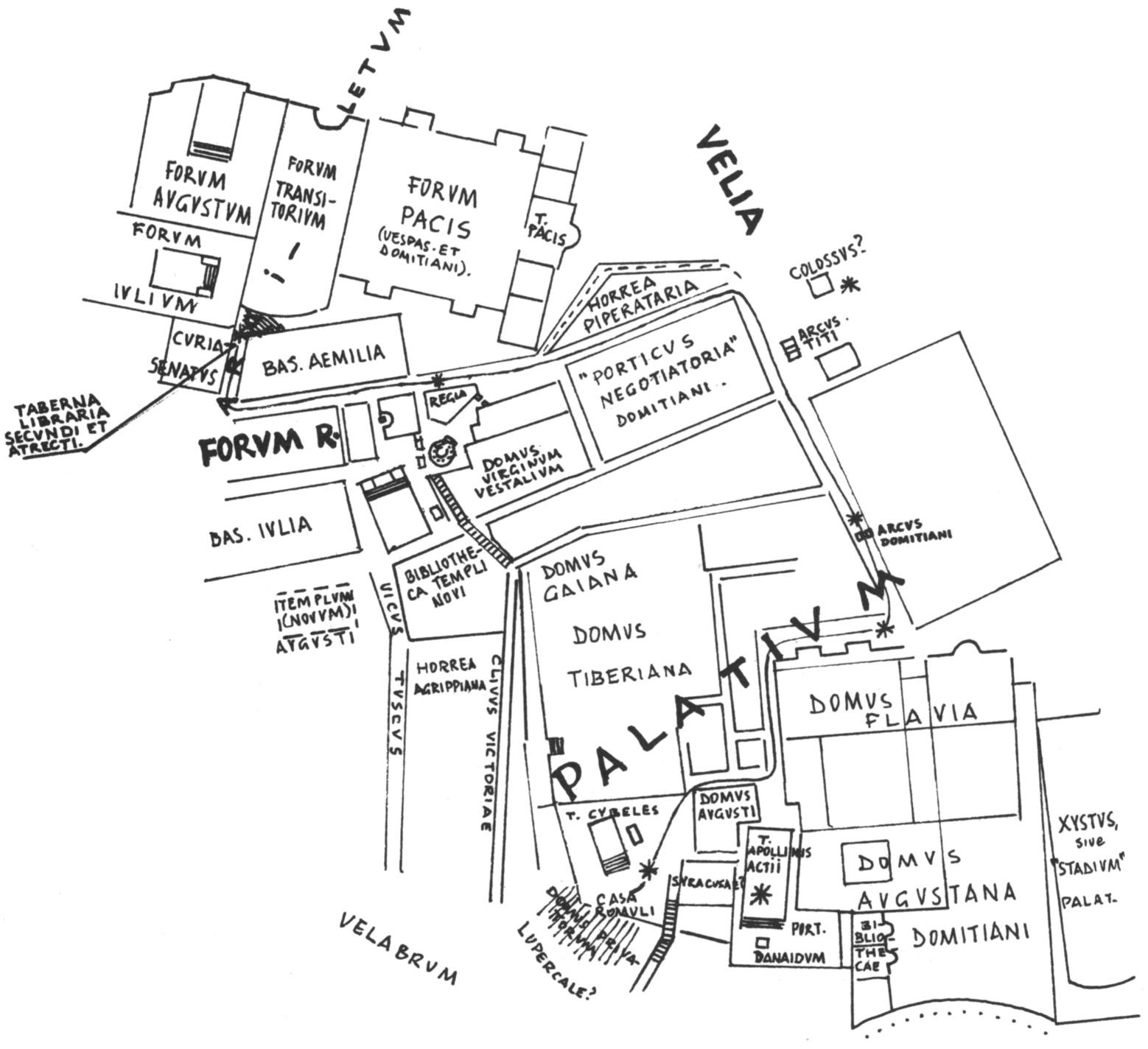
Planimetria ricostruttiva con la localizzazione della Taberna Libraria di Secondo e Atrecto nell'Argileto e nel Vicus Tuscus (da Rodríguez-Almeida 1982-83, p. 94, fig. 3)

Planimetria dell'area indagata dell'Argileto in cui sono visibili, a nord di 502, gli stipiti di ingresso dell'ambiente a pianta mistilinea (da Carnabuci 1989, p. 152, fig. 119)
About the author
Marta Maria Perilli - 0000-0001-6883-7286
Università degli studi di Firenze
Informations
Cita come: Marta Maria Perilli, Bookshops of the Western Area_Scheda Letteraria, anno 2023, DOI 10.35948/DILEF/Dalib/38 contenuto in Valeria Piano, Barbara del Giovane (a cura di), DaLiB. Dal Libro alla biblioteca, DILEF Unifi 2023.
Ricevuto il: 19/08/2023
Pubblicato online il: 28/09/2023
DOI: 10.35948/DILEF/Dalib/38
Copyright e licenza d'uso: https://dalib.it/contenuti/informativa/8261
Progetto finanziato da: