- Original paper
- Open access
The "Villa of the Papyri" Library in Herculaneum
Fa parte di Biblioteche private/Altre biblioteche private di area occidentale
Francesco Cannizzaro - Pubblicato online il 28/09/2023 - DOI: 10.35948/DILEF/Dalib/16
Description
During the eighteenth-century Bourbon excavations to uncover the ancient city of Herculaneum, buried by the pyroclastic flow from the eruption of Vesuvius in the autumn of 79 CE,[1] in 1750 military engineer Karl Weber discovered the remains of a magnificently luxurious villa. Numerous book rolls of carbonized papyri (already identified as such in 1752) were found inside it, offering a unique look into a sizeable private library of the classical world.
The Villa and the Library
Over 1,800 papyri have been inventoried from the so-called “Villa of the Papyri”. They are from a number of book rolls that varies, depending on scholars’ estimates, from 650-700 to more than 1,000. What is more, one must consider that some papyri were certainly destroyed between 1750 and 1752 and during the first attempts to unroll them.[2] The majority of the book rolls are in Greek and on philosophical themes that can be related to Epicureanism; a minority, between 60 and 80, totalling around 100 papyrus fragments in all, are in Latin. As a whole, this second group is less studied, with the investigations carried out thus far revealing a certain interest in history and law.
It has been determined that a large part of the library found in the “Villa of the Papyri” is that of the Epicurean philosopher, Philodemus of Gadara. On one hand, his writings make up the most significant corpus of legible papyri (excepting any new book rolls that may be opened or new findings that may be made there of course); on the other hand, some of the Philodemus book rolls are drafts or, nevertheless, works not for publication and, while in theory it is not impossible, it would be hard to imagine that these rolls would be housed anywhere but the author’s library.[3]
This we know about Philodemus: he was born in Gadara in the Decapolis around 110 BCE. After a probable journey to Alexandria (and perhaps a trip to Sicily), in Athens he was a disciple of the Epicurean Zeno of Sidon. After the death of his teacher, presumably around 75 BCE, he moved to Italy, specifically to Campania (P.Herc. 339, col. XXI 7-13 Dorandi, corresponding to P.Herc. 155, col. XV 15-22, Phld. Sto.)– where he lived until his death, after 40 BCE.[4] Thanks to the crucial testimony of Cicero (Cic. Pis. 68-72 passim, in particular 68-70; see Ascon. Pis. p. 14, 24-25 Clark), we can establish that during his long stay in Italy, Philodemus’ main patron was Lucius Calpurnius Piso Caesoninus, father-in-law of Caesar and one of the most visible politicians of his era: all trace of him, consul in 58 BCE, proconsul in Macedonia the following year and attacked by Cicero in 55 BCE, is lost after 43 BCE; having survived the unrest of the civil wars, his son, known as Caesoninus Pontifex, would hold the prestigious office of praefectus Urbi from 12 to 32 CE, the year of his death. Philodemus himself also confirms his close ties with the Piso family: a famous epigram of his (Phld. epigr. 27 Sider, i.e. AP 11, 44) and the work De bono rege secundum Homerum (P.Herc. 1507, col. XLIII 15-19 Dorandi, Phld. Hom.) are dedicated to Piso Caesoninus, whose clement and moderate conciliatory political conduct is in effect compatible with the reception of Philodemus’ teaching.[5] On the other hand, a testimony from Catullus is more uncertain, only attaining value if Philodemus is identified as the Socration in Piso’s retinue (see infra).
Given the bond of patronage between Philodemus and the Calpurnii Pisones, it is very probable that the philosopher’s library was situated in his patron’s villa, where Philodemus himself may have operated in a later phase of his life[6] or where Caesoninus Pontifex may have had the library brought following Philodemus’ death. Therefore, the “Villa of the Papyri” would be the villa of (or designed by) Piso Caesoninus, then presumably passed down to his son Caesoninus Pontifex. This hypothesis, initially formulated by Comparetti, has been widely taken up among Herculaneum scholars. Of course, it would be more robust if, as thought until the end of the twentieth century, the villa had been datable to the first half of the first century BCE. However, on the basis of new excavations,[7] the dating of the villa has been brought forward, to 50-25 BCE, when the lives of Calpurnius Piso and Philodemus are shrouded in uncertainty. So, it is easy to understand the central role the new dating of the villa assigns to Caesoninus Pontifex, possibly the person to whom Horace dedicated the Ars poetica, which is certainly related to the works of Philodemus (see infra).
Further linking Philodemus, the Pisones and the “Villa of the Papyri” are some testimonies from the poet-philosopher’s surviving works: one of his epigrams (Phld. epigr. 29 Sider, 5-6, i.e. AP 9, 412, 5-6) may make reference to the villa’s belvedere and the way down to the sea; the incipit of two epigrams that can be attributed to him mentions Parthenope (P.Oxy. LIV 3724, col. IV 14-15 Sider); one of his writings, come down to us in very mutilated conditions, mentions Siro and Naples and, perhaps, Herculaneum (P.Herc. 312, pz. 1 col. IV 5-13 Gigante [see Indelli 2018, p. 145]).[8] Lastly, mention needs to be made of the fact that, according to many scholars, a large part of the decorations and sculptures in the “Villa of the Papyri” [see BIBERC-AR] suggest an Epicurean sensitivity, albeit alongside an interest in political life: a profile well fitting the Calpurnii Pisones, as far as we can reconstruct from our historical sources and Cicero’s invective.[9] Unfortunately, we continue to lack conclusive evidence that unmistakably connects the “Villa of the Papyri”, the Calpurnii Pisones and Philodemus: nonetheless, all other hypotheses as to whom the villa belonged to prove less viable.[10]
As for the library found in the villa, there is no proof of a clear division between a Greek section and a Latin one, like in some public libraries of the same era [see BIBATR-LET and BIBPAL-LET].[11] The majority of the Greek book rolls, together with some Latin papyri shut in a wooden crate, were found in a small room (marked with the number “V” on the map drawn by Karl Weber), which perhaps acted as a store room, as can be deduced from the presence of cupboards and shelves. The reading room was in all likelihood the room known as the tablinum. With a lot more light, both the Greek and Latin “books for consultation” were found here. The rest of the papyri were found in room XVI next to the tablinum and in the peristyles, both in crates and loose.[12]
The Greek book rolls found can be divided into three groups of varying size, from different times. The first group includes papyri from before Philodemus’ lifetime, dating to the third and second centuries BCE (perhaps the oldest is P.Herc. 1413/1416, which can be traced back to the third or even the end of the fourth century BCE). They are works by the teachers of Epicureanism, from Epicurus to Demetrius Laco. In all likelihood, they are works that Philodemus collected before he came to Italy and that could well come from the Kepos library.[13] The second and largest group of book rolls, varying in quality from first drafts to magnificent volumen, is made up of papyri written during Philodemus’ lifetime and period of activity (first century BCE): they are mainly his own works, in addition to some copies of earlier works. Last, the third group dates from after Philodemus’ lifetime (end of the first century BCE – first century CE): it includes copies of works by Philodemus, by other Epicurean authors or by authors from other philosophical schools (e.g. Chrysippus). This is important evidence of the fact that even after Philodemus’ death, the library continued to be frequented and was used for reading and study.[14]
As for the Latin book rolls, everything is made much more difficult by the terrible conditions in which they have come down to us: probably dating from the last phase of the library (first century BCE – first century CE), the illusion that some of them contained poetic texts by Lucretius, Ennius and Caecilius Statius has dimmed. The rolls whose contents have been identified are very likely poems about history and works on history, politics and law relating to the contemporary world (Augustan era and early imperial era). As things stand, the only Latin text that is not anonymous is the historical work by Seneca the Elder and the most famous poem is without doubt the so-called carmen de bello Aegyptiaco (or Actiaco), of uncertain date but according to some recent studies retraceable to the second half of the first century CE. They are precious testimonies that, if verified, would confirm the continuation of some library activities in the villa a long time after the Augustan era, almost until the eruption of 79 CE.[15]
Philodemus, His Library and Late-Republican and Augustan Rome
Of central importance is the relationship between Philodemus (and his library) and the cultural milieu of late-republican and early-Augustan Rome, about which many aspects remain to be clarified. A premise is needed: Epicureanism was very much widespread in Rome at the time among many even leading political figures, such as Piso Caesoninus himself, Cassius, Atticus, Pansa, Manlius Torquatus, Trebatius Testa and, probably, Caesar: of course, this does not mean that Epicurean orthodoxy necessarily became a rule of life for them, nor, even less so, that it should be postulated that they each had contacts with Philodemus (or with Siro).[16]
There is no doubt that Cicero was in contact with Philodemus, as shown by the passages from the abovementioned treatise De finibus bonorum et malorum and the speech In Pisonem; it is likely that the two already met when Cicero was attending Zeno of Sidon’s lectures in Athens (79/78 BCE). In the absence of sound biographical and prosopographical information better defining the relationship between the two,[17] it is nevertheless likely that Cicero read Philodemus’ works and made use of them in the composition of his own treatises.[18] For example, Cicero almost certainly used Philodemus’ De pietate and other of his logical and theological works for the composition of Book I of De natura deorum, which draws a polemical doxography of other theological views prior to expounding Epicurean theory on the gods.[19] In the ethical sphere, both the De finibus itself and the Tusculanae Disputationes have been analysed for Philodemus’ influence: there is no conclusive evidence, but some common themes – the Epicureans’ political commitment, their focus on virtus albeit within a pleasure-based ethics, the importance of amicitia, the reflection on death and related fears – present such close correspondences with some of the treatises written by (De bono rege secundum Homerum, De morte, but also De ira and De adulatione) or attributed to (“Ethica Comparetti”) Philodemus that various scholars have imagined a direct link between the two authors.[20] Finally, on the topic of rhetoric, the three works of Cicero’s older years (De oratore, Brutus and Orator) have been read in relation to Philodemus’ De rhetorica, but, as with the ethical works, there are no elements linking them.[21]
What is more complex to establish is whether and to what extent Philodemus was in contact with or used as a model by poets such as Catullus and Lucretius. As for Catullus, Catull. 13 (Fabullus’ “invitation to dinner”) was read in parallel to Philodemus’ above-cited epigram (Phld. epigr. 27 Sider, i.e. AP 11, 44); more generally, the hedonistic conception of the poetry, the Callimachean refinement of the style, and the focus on love and amicitia, together with some parallels in the text itself, have led to believe that the poetry and poetics of Catullus and Philodemus were closely linked.[22] On the other hand, behind the character of Socration attacked, along with a certain Piso, in Catull. 47, it is tempting to see a reference to the philosopher Philodemus, and his protector Piso Caesoninus: if true and taken at its word, this testimony would contradict the picture drawn above. The positions taken by the critics cover the whole spectrum: the personal attack in Catull. 47 is a joke or nevertheless does not undermine the poetical harmony between Catullus and Philodemus; Catull. 47 should not be taken into account because it is unlikely that Catullus is alluding to Philodemus; Catullus is actually highly polemical towards Philodemus in his poem 13 (Catull. 13) and elsewhere too.[23] If we are to go on to Lucretius, there is even more uncertainty: the discovery of an edition of De rerum natura among the ashes of Herculaneum was thought to be evidence (albeit not conclusive) of contact between the two most famous Epicureans in contemporary Italy, but this proved to lack solid grounds.[24] It is clear that many aspects shared by Lucretius’ poem and the Philodemus’ treatises can be traced back to their shared philosophical base: ultimately, there are few points that would exclusively bind Philodemus and Lucretius, and, given the loss of a large part of the Epicurean philosophical writings preceding Philodemus, those few points are hard to deem as proof.[25] Vice versa, it would be equally imprudent to imagine a clear separation between Philodemus, the alleged innovator, and Lucretius, the alleged fundamentalist follower of Epicurean doctrines: they diverge in their poetic language, aim their polemics at different targets, perhaps even have a different notion of political engagement, but these contrasts are often more apparent than real. Indeed, if one is to look at the whole picture, they can be reconciled, or considering that the audiences of Philodemus’ and Lucretius’ writings overlapped but were not the same, at any rate explained.[26]
The grounds for the relations between Philodemus and the Augustan era poets are more solid. The ancient biographical and scholastic tradition on Virgil, along with some passages from the Catalepton and Georgics (Verg. catal. 5, 8-10; Verg. catal. 8; Verg. georg. 4, 563-566; see e.g. Serv. ad Verg. Aen. 6, 264), point to the poet spending periods of time in Campania and frequenting Siro.[27] But above all, Virgil himself, Varius, Tucca and Quinctilius Varus – the “gang” [brigata] (I am borrowing an expression of Marcello Gigante) mentioned in Prob. vita Verg. p. 198, 3-6 Brugnoli-Stok – are the dedicatees of at least some books of Philodemus’ De vitiis et virtutibus oppositis: since the nineteenth century, as of the studies of Alfred Körte, it was thought that in severely mutilated passages of P.Herc. 253 and P.Herc. 1082, Philodemus named some of the most celebrated intellectuals of the early Augustan era. Now there is definite confirmation of this following the finding and reading of P.Herc.Paris. 2, fr. 279, 7-13 Delattre, again belonging to De vitiis, in which the four are explicitly named in connection with slander.[28] Based on these presuppositions, many works have been written on how the Epicureanism that Virgil absorbed through Siro, Philodemus and his library influenced the composition of his works, particularly the Bucolics and Georgics. In addition, a whole range of studies have dwelt on the Aeneid itself. The epic-heroic poem may seem distant from Epicurean precepts, but its various representations of wrath and royalty, reflection on the prerogatives and limits of the Olympian gods, and the traits of characters such as Mezentius and Aeneas himself, appear to relate to the writings found in the “Villa of the Papyri” library.[29]
As for Varius, friend and executor of Virgil’s will, the few fragments of his that have come down to us give the idea of an affinity with the Herculaneum milieu: his De morte appears to be a didactic hexameter poem, perhaps modelled on Philodemus’ De morte, and the polemic against Mark Antony can be understood in light of the attitude held (temporarily) in 44 BCE by Piso Caesoninus.[30]
After Cicero, Horace is the only ancient author to mention Philodemus (Hor. sat. 1, 2, 119-122): in effect, in some of his epigrams he – auctoritas for those who desire the greatest pleasure in love through the least effort – expressed the desire for a Venus parabilis facilisque (e.g. Phld. epigr. 22 Sider, i.e. AP 5, 126).[31] The mention of mutual friends Tucca, Varius and Virgil both in Hor. sat. 1, 5, 40 and Hor. sat. 1, 10, 81 and in P.Herc.Paris. 2, fr. 279, 7-13 Delattre also seems to point to a relationship between Philodemus and Horace.[32] In general, the books of the Sermones are filled with elements that can be traced back to Epicureanism as reread by Philodemus: not only the behaviour in the face of eros, but, among other things, the consideration of riches and friendship, the frank tone and the admission of one’s weaknesses. A similar closeness can be detected in Book I of the Epistulae: openly eclectic, the epistles nevertheless present Horace as a pig from Epicurus’ herd (Hor. epist. 1, 4, 15-16). What is more, several epistles seem to be influenced by Philodemus’ lessons: for example, in the ethical interpretation of Homer, the attitude towards patrons and death, and even the poet’s self-portrait.[33] Conclusive evidence of the relations between Horace, Philodemus and his library could come from the Ars poetica, if it could be established that the Pisones to whom Horace dedicates his epistle really are the children of Caesoninus Pontifex (as Porph. ad Hor. ars. 1 asserts). Although we do not have this certainty, a close dialogue can still be felt between entire sections of the Ars, especially when it emphasizes the inseparable connection between content and form in poetry, and Philodemus’ De poematis.[34] Beyond the hexameter works, Horace’s Odes have also attracted the attention of critics seeking an Epicurean basis, traceable to Philodemus in particular. Indeed, the rejection of Epicureanism in Hor. carm. 1, 34 has mainly failed to convince scholars and, from the tone of Maecenas’ invitation to dinner to the final words about the sage’s behaviour, Hor. carm. 3, 29 has also been read from Philodemian perspective.[35]
The relations between Philodemus’ production and the Latin elegiacs of the Augustan era have recently been the subject of investigation: among Tibullus, Propertius and Ovid, it is perhaps the second, Propertius, tellingly also related to Virgil and Maecenas, who is most affected by some Philodemus models. Nevertheless, the subject deserves further investigation.[36]
The final matter of debate is how much Philodemus influenced Latin and Greek authors of the imperial era: in the Greek sphere, attention has mainly focused on prose writers such as Paul of Tarsus, Plutarch, Lucian and Sextus Empiricus; in the Latin sphere, Seneca, Petronius and Martial.[37] Statius is a promising author who, by virtue of his Campanian origin and the Epicureanism professed by some of his patrons (principally, Pollius Felix, whose villa in Sorrento is described in silv. 2, 2), may have been influenced by Philodemus and even seems to preserve traces of his Epicurean readings in his heroic epos.[38]
In 79 CE Philodemus’ library was submerged by the flows from Vesuvius and gradually the very memory of the philosopher faded (Schol. ad Hor. sat. 1, 2, 121 [Keller II, p. 32, 10-16]): some of his philosophical works were in circulation, at least until Diogenes Laertius (Diog. Laert. 10, 3), while quite a sizeable corpus of epigrams, which have come down to us in the Anthologia Palatina, have had better luck. However, Philodemus and his library would have to wait until the eighteenth century to return fully to the scholars’ attention.
Select bibliography: Recent introductions to the villa and its library include Sider 2005, Delattre 2006, Houston 2014, pp. 87-129, and Capasso 2017. Even more recently, see Lapatin 2019, focusing on the archaeological aspect, Capasso 2020a, Longo Auricchio et al. 2020 and Fleischer 2022; the bibliography put together in Henry 2013 is now somewhat out of date; Sampaolo’s 2014 summary is useful, but not always accurate. Erler 1994, Sider 2005, Delattre 2006, Travaglione 2008, Capasso 2020a and Longo Auricchio et al. 2020 have been fundamental for the list of “Authors and Works”. On the Latin papyri see, in particular, Capasso 2011; the THV portal (https://epikurwuerzburg.de/aktivitaeten/editio/thv/) is useful; for dating the papyri and reconstructing the titles of the works where the subscriptio is present, see Del Mastro 2014.
In support of the autumn date rather than the commonly accepted date of 24 August, see Pappalardo 2019 and Fleischer 2022, p. 7. ↑
A run-through of the bibliography to date and new considerations on the size of the Herculaneum library can be found in Carrelli 2016. Most of the papyri that are legible today were unrolled by mechanical means, in particular using the so-called “Piaggio machine”, named after its creator, Scolopian father Antonio Piaggio, who arrived in Herculaneum in 1753. Currently, having realized the risks associated with opening the rolls by mechanical means and given the substantial failure of chemical techniques, non-invasive technologies such as X-ray computed tomography are being tested for reading the as-yet-unopened rolls; in addition, campaigns have been undertaken and are still ongoing to digitize the already unrolled papyri using multispectral and hyperspectral imaging and Reflectance Transformation Imaging (RTI) technology. Particularly up to date in this regard is Fleischer 2022, pp. 62-71, which also seeks to calculate the amount of text in the as-yet-unopened rolls (pp. 72-79); new hopes are now also being given by the use of artificial intelligence. Lastly, see Seales et al. 2023. ↑
On this latter aspect, see especially Dorandi 2007; among the modern critics, Houston 2014, pp. 95-96 and 113-114 fails to be convinced. ↑
On the early stages of Philodemus’ life, see Fleischer 2018. For a look at his whole life, in addition to Capasso 2020a, see the different perspectives of Blank 2019 and Longo Auricchio 2019; a recent bibliography on Philodemus can be found in Essler 2019. ↑
On the figure of Piso Caesoninus, see especially Griffin 2001, Benferhat 2005, pp. 173-232, and Fish 2019. However, it must also be pointed out that Philodemus was in contact with other prominent politicians: Cic. fin. 2, 119 suggests that Philodemus was among the familiares of Lucius Manlius Torquatus (interlocutor in Cicero’s dialogues, who committed suicide during the civil war between Caesar and Pompey) and, perhaps, of Cicero himself; Book IV of the Rhetoric, as Dorandi 1996 has shown, is dedicated to Pansa, the consul of 43 BCE, but we have no evidence that he (or potentially any other political figure) was Philodemus’ patron. ↑
In any case, it should not be assumed that Philodemus resided in his patrons’ villa: in fact, the aforementioned epigram suggests that he lived somewhere else nearby. ↑
See Guidobaldi - Esposito 2009 and Guidobaldi - Esposito 2010; summary in Camardo 2019. For further details, see BIBERC-AR. ↑
It was in particular Marcello Gigante (e.g. in the posthumous Gigante 2004, p. 91; see previously Gigante 1990, pp. 69-79, on Philodemus and the “Villa of the Papyri”) who gave biographical weight to these (and even more hypothetical) cues: see most recently Indelli 2018 and Longo Auricchio 2019. However, these testimonies are either difficult to contextualize (this is the case with P.Herc. 312) or subject to some scepticism (e.g. Sider 1997, pp. 167-168, and Maltomini 2003, who points out that Philodemus’ authorship of the incipits of the epigrams in P.Oxy. LIV 3724 is not a given). See now also Capasso 2020a. ↑
Here I will only mention Pandermalis 1971 and Hallett 2019. In the Epicurean context, he identified an interesting parallel (p. 96 n. 101) between the portraits of Hellenistic kings in the “Villa of the Papyri” and the portraits of generals that, according to the testimony of Stat. silv. 2, 2, 69, decorated the Sorrento villa of Epicurean Pollius Felix. As for the sculptures in the villa, the identification of the subject of a bronze portrait as Caesoninus Pontifex, which would bear great weight in identifying the villa’s owners (Adamo Muscettola 1990), is not certain. ↑
A summary of the matter is found in Capasso 2010: most scholars now accept that the villa belonged to Piso Caesoninus and/or Caesoninus Pontifex; some scepticism can be seen in Houston 2014, pp. 124-125. The hypotheses that the villa’s original owners were either members of the Claudii Pulchri or a certain Marcus Octavius, identified as the curule aedile of 50 BCE, whose name was found at the foot of two non-Philodemian Herculaneum papyri, have enjoyed success among the critics. For a refutation of these theses, which are more unlikely than the traditional one, and a brief overview of other hypotheses, please see Longo Auricchio et al. 2020, pp. 186-191. Finally, see Dorandi 2017, who, discussing Houston 2014 in light of the new dating of the “Villa of the Papyri”, believes that even if the Calpurnii Pisones were not the owners of the villa, it is still more convenient to think that much of the library found there was that of Philodemus. ↑
More likely, as Radiciotti 2009, p. 110, says, they were a “set of Latin papyri, inserted in the Greek library collection”. ↑
On the locations where the papyri were found, see most recently Capasso 2020b, with bibliography to date. Specifically on the Latin papyri, see Capasso 2011, pp. 13-22. The discovery of both Greek and Latin papyri in crates has raised questions: it has been thought that they had been put into storage in order to be taken away after seeing the warning signs of the eruption or because of restoration work underway at the villa, but perhaps it was simply how the rolls were kept in the store room and taken from one room to another for reading (Cavallo 2015, pp. 4-6). ↑
Among others, Houston 2013, pp. 188-189 and 192-193, points out that there are alternative hypotheses to the above and that some of these books, which were nothing short of antiques, may have come to Herculaneum because, for example, they had been purchased on the book market by the owner of the villa; see also Houston 2014, pp. 120-125. For a discussion of Houston’s arguments, see Capasso 2017, pp. 55-57, and Dorandi 2017. ↑
On the dating and graphic and bibliological features of the Greek papyri, please see the unsurpassed Cavallo 1983 (and 2015, a quick summary): the scholar has also sought to identify the scribes of the papyri, one of whom appears to be a certain Poseidonatte, whose name is found at the bottom of P.Herc. 1426 (on Poseidonatte, see also Houston 2014, pp. 114-115, and Capasso 2017, p. 61). For the dating and study of the papyri with a subscriptio, some of which were written in the first century CE, see Del Mastro 2014. ↑
On the Herculaneum corpus of Latin papyri, following the studies of Radiciotti 1998, Radiciotti 2009 and Ammirati 2010, pp. 29-33 (reprinted and updated in Ammirati 2015, pp. 23-25), see the more recent summaries in Capasso 2011, 2013, 2017, pp. 64-68, and, lastly, Dorandi 2020. On the carmen, traditionally attributed to Rabirius or Varius and dated to the Augustan era, see Lucarini 2021 (with bibliography to date), who proposes dating it to the times of Nero or Flavius. On P.Herc. 1067, containing a historical work of Seneca, see at least Piano 2017 and the essays contained in Scappaticcio 2020. ↑
The leading work on the Epicureans in Rome in the late republican era and their political positioning, a topic debated since the time of Arnaldo Momigliano, is Benferhat 2005; see more recently Gilbert 2015, the essays in Yona - Davis 2022 and Gordon 2023, pp. 33-37. On Caesar and Epicureanism, see Volk 2022: it should be remembered that Caesar was Piso Caesoninus’ son-in-law and may have known Philodemus personally; moreover, Calpurnia herself, daughter of Piso Caesoninus and wife of Caesar, seems to have been of Epicurean sympathies (see Fish 2019). ↑
Unfortunately, in light of more recent studies, the idea that Philodemus’ P.Herc. 986, fr. 19 is a specific reference – almost a dedication – to Cicero appears to lack solid foundations (see Capasso 1992, with bibliography to date). On the other hand, the mysterious Gaius Bruttius, dedicatee of a work by Philodemus on the gods (P.Herc. 89/1383/1301; on the title see Dorandi – D’Angelo 2023), might have been one of the teachers of Cicero’s son in Athens (D’Angelo 2021). An attractive, but essentially indemonstrable hypothesis (see Tilg 2006) is that the cantores Euphorionis mentioned in Cic. Tusc. 3, 45 were the Epicureans in Philodemus and Siro’s circle. ↑
Delattre 1984 believes that Cicero even drew pithy Greek expressions from the works of Philodemus for his own epistles to Epicurean correspondents. Obviously, the great uncertainty about the chronology of his works affects the relations between Philodemus and his contemporaries (Cicero, but also Catullus and Lucretius). On the spread of Philodemus’ works outside the “Villa of the Papyri”, see Capasso 2017, pp. 61-64, with a discussion of the bibliography to date. ↑
Cicero’s De natura deorum has been studied in comparison with De pietate since Diels (see McKirahan 1996 and Obbink 2001; see the status quaestionis in Montarese 2012, pp. 31-35), with De deorum victu (Essler 2011a; summary in 2011b) and with De signis (Auvray-Assayas 1992 [1991]; see also Asmis 1996); see also Gilbert 2015, pp. 207-10, with additional bibliography. Last, Sedley 2018, p. 117 considers it likely that not so much Philodemus as Zeno of Sidon is behind the account of Epicurean theology in De natura deorum. ↑
See Tsouna 2001; Armstrong 2011; Delattre - Tsouna 2020. More sceptical are e.g. Erler 2001 and Gilbert 2015, pp. 245-249. ↑
Gaines 2001 (and 2004) is convinced of a direct relationship between Philodemus’ De rhetorica and Cicero’s rhetorical works; Wisse 2001 shows some perplexity. ↑
See Marcovich 1982; Landolfi 1982; Sider 1997, pp. 64 and 129; more recently, Tilg 2006, p. 79, and Kayachev 2013, p. 418. In the uncertainty of the chronology, it would in any case be more likely that Philodemus, author and theorist of poetry, influenced Catullus, who often drew on Greek models, than the other way around. ↑
For these positions, please see, respectively, Tilg 2006, p. 79 n. 38; Shapiro 2014 (with a useful bibliographical status quaestionis); Gale 2022. ↑
Knut Kleve believed that P.Herc. 395, 1829, 1830 and 1831 contained fragments of Lucretius’ De rerum natura (I will only cite Kleve 1989). In other contributions, the same scholar pointed to Latin literary works in P.Herc. 21 and 78: respectively, a book of Annales by Ennius and a play by Caecilius Statius. His theses have been refuted by several critics: see, among others, Capasso 2003, pp. 78-99, Beer 2009a, Capasso 2011, pp. 63-86; specifically on P.Herc. 78, now see Breuer 2021. In any case, as has been argued (see e.g. Sider 1997, p. 24), whether or not a manuscript of Lucretius’ work was found would in no way testify to a personal connection between Lucretius and Philodemus or to a connection between their works. ↑
See especially Kleve 1997, with discussion (and run-through of the studies to date) in Capasso 2003, pp. 101-104. Despite its title, Dorandi 1997 does not focus on the relationship between Philodemus and Lucretius. Armstrong 1995, Erler 2003 and Schroeder 2004 deal with the philosophical and methodological principles that can be found in Philodemus’ works and that are applied in De rerum natura, namely the impossibility of any shifts (or metalepsis), empirical calculation applied to ethics (epilogismos), and distancing oneself from the passions (avocatio): similar objections can be made to those on the content. More recently, Beer 2009b and Rover 2023 (with additional bibliography) have been in favour of the idea that several features of De rerum natura refer back to, or at least are in harmony with, Philodemus’ works. ↑
On a clash or nevertheless clear separation between the “fundamentalist” Lucretius and Philodemus, see e.g. Sedley 1998, pp. 65-68 (taken up in later essays by the same author), and Maslowski 1978, discussed by Capasso 2003, pp. 101-102. On their poetics, a contrast has been pointed out between the light-hearted poetry of Philodemus, compatible with Epicurus’ maxims, and Lucretius’ choice of philosophical poetry, which seems to contradict the teacher’s precepts (see Freer 2019). In actual fact, neither Lucretius nor Philodemus uses poetry as a means to expound new philosophical research (presumably the target of Epicurus’ criticism). Neither do they devalue the poetic form. Moreover, the communicative aim of the De rerum natura, which can explain the absence of polemics with the Stoics, makes Lucretius’ “heresy” appear less serious: see especially Asmis 1995, Arrighetti 1998 (and 2006, pp. 342-370), Beer 2009b, pp. 54- 165, and Janko 2011, pp. 230-231. See also the recent Montarese 2012, pp. 3-4 and 171-177, McOsker 2020 and O’Keefe 2023. On Philodemus, Lucretius and politics, see the attempt at conciliation in Fish 2011, which other critics have taken even more to the extreme (see Trotz-Liboff 2023, pp. 421-422, with bibliography to date). ↑
In fact, the Vitae Vergilianae do not clarify whether Virgil took up residence in Naples during his schooling, during adulthood, or at both times (see Stok 1993). Obviously, the question – which is far from finding a solution (also thanks to the debate over the authenticity of the Catalepton) – would have no little bearing on Philodemus’ biography: if Virgil had frequented him after the publication of the Bucolics (39 BCE), this would imply that Philodemus died quite a few years after 40 BCE. It is also unclear where Virgil met Philodemus: indeed, were they to have frequented each other during their youth, the “Villa of the Papyri” may have still been under construction. ↑
See above all Gigante - Capasso 1989 and, with regard to P.Herc.Paris 2, Delattre 2004. Of the pivotal passage in P.Herc.Paris 2, fr. 279, 7-13 Delattre (the subsequent editions in Delattre 2018, p. 114, and Puglia 2023, p. 133, made no substantial changes to the text) here is an English translation based on the Italian version by Indelli 2018, p. 149: “So, such things we like to say about these (or: these things) and, in general, about slanderers (or: about slanders, if we read διαβολῶν instead of διαβόλων), or Plotius, Varius, Virgil and Quintilius; instead, the disciples of Nicasicrates...”. ↑
See the contributions collected in Armstrong et al. 2004. Precursors are Tait 1941, pp. 48-63; Barchiesi 1978, pp. 118-119; Galinsky 1988, pp. 335-337; Cairns 1989, pp. 1-28 et passim; Erler 1992. On Mezentius, see Kronenberg 2005; Fish 2004 shows how the study of Philodemus’ work On the Good King According to Homer can also make a contribution to issues such as the authenticity of the episode involving Helena. Recently, on the Aeneid, see Keith 2021b and Hedrick III 2023 (with bibliography to date); on the Epicureanism underlying the Bucolics, see Davis 2012, Bing 2016 and Douglas 2017; on the Georgics, see Zago 2017, Freer 2019 and Trotz-Liboff 2023; on Ciris et Aetna, see Winters 2024, Verde 2020, Piergiacomi 2024. Unfortunately, I was unable to consult Freer 2014; on the influence of Philodemus Epicureanism in Virgil and Horace, see also Davis 2020. ↑
See Rostagni 1959, Hollis 1997 (updated in Hollis 2007), Gigante 2001, pp. 18-23, and Citroni 2019: in agreement with recent criticism (see the same Citroni 2019, pp. 53-54, with brief bibliographical overview, and Lucarini 2021), I do not consider Varius the author of the Carmen del bello Aegyptiaco. On the other hand, he cannot be ruled out as hiding behind the mask of Lynceus in Prop. 2, 34 (see Cairns 2004 and Cairns 2006, pp. 295-319, which takes up an old hypothesis of Jean-Paul Boucher); in this regard, scepticism is expressed in Citroni 2019, p. 53, with further bibliographical references. ↑
On Hor. sat. 1, 2 and Philodemus, see Gigante 1993 and Yona 2018, pp. 106-119, and Keith 2021a, pp. 147-150; on eros in Epicureanism, between Philodemus, Lucretius and Horace, now see Davis 2024. ↑
Actually, some scholars believe that the connection between the above texts is direct: see e.g. Gigante 2004, pp. 87-88, and the recent discussion in Puglia 2023, pp. 134-136. ↑
Yona 2018 is now the leading reference for Horace’s Sermones and Epicurean ethics. See, among other recent contributions, Kemp 2010 and Armstrong 2014 (who is convinced that Philodemus was still alive in 35 BCE, the year of the publication of Book I of the Sermones). On Book I of the Epistulae, see Armstrong 2004 (plus a note in Kayachev 2013, pp. 420-421). ↑
On Horace’s Ars and Philodemus’ De poematis, see at least Armstrong 1993 (with a run-through of the bibliography to date, as well as dating and addressees of the epistle), Oberhelman - Armstrong 1995 and Tsakiropoulou-Summers 1995. More recently, see Janko 2000, especially pp. 6-10 and 190-191, Janko 2011, pp. ix and 213-215, and Janko 2020, pp. 162-166. ↑
For a general view, with bibliography to date, see Armstrong 2004 and 2014 (passim) and especially Keith 2021a, pp. 150-155. Douglas 2022 analyses the Epicureanism behind the rejection in Hor. carm. 1, 34; see Davis 2023 and 2024 (on other Horatian Odes: 1, 1; 1, 5; 1, 33; 2, 9; 2, 16). ↑
See Keith 2021a, pp. 155-165. After the pioneering Tait 1941, pp. 76-83, see at least Booth 2001, Cairns 2004 and Kayachev 2013 (all three on Propertius). On Philodemus and Sulpicia, in the Corpus Tibullianum, see Hanses 2024, especially pp. 64-69. ↑
On Philodemus and Lucian’s The Fisherman dialogue, see Holland 2004. On Philodemus and New Testament literature, particularly the Pauline epistles: see Glad 1995, some essays in Fitzgerald – Obbink – Holland 2004 and, last, Allison 2020. Gigante 1981, pp. 215-221, and Longo Auricchio 1984 have focused on the conception of music and rhetoric in Sextus Empiricus and Philodemus. On Seneca and Philodemus, see Gigante 2000 and, on the problem of wrath, Tsouna 2011; Tsouna 2011, along with Erler 2003, also discuss Plutarch and Philodemus. Raith 1963 is the leading essay on Epicureanism in the Satyricon. On Epicurean elements in Martial, perhaps of Philodemus descent, see already Tait 1941, pp. 83-86 and, more recently, Keith 2019 and 2020. On the reception of Epicureanism in some authors of the imperial era, see also Erler 2009 and the salient contributions in Mitsis 2020 and Davis – Yona 2024. ↑
On Statius, author of the Silvae, and Philodemus, see André 1996 and, in specific reference to silv. 2, 2, Sbordone 1977 and Schroeder 2004. On Epicureanism and the Thebaid, see e.g. Chaudhuri 2014, Reitz 2017, Pontiggia 2018 and Cannizzaro 2024. ↑
Bibliography
Adamo Muscettola, S. (1990), Il ritratto di Lucio Calpurnio Pisone Pontefice da Ercolano, «CErc» 20, pp. 145-155.
Allison, J.R. (2020), Saving One Another: Philodemus and Paul on Moral Formation in Community, Leiden-Boston.
Ammirati, S. (2010), Per una storia del libro latino antico: i papiri latini di contenuto letterario dal I sec. a.C. al Iex.-IIin. d.C., «Scripta» 3, pp. 29-45.
Ammirati, S. (2015), Sul libro latino antico. Ricerche bibliologiche e paleografiche, Pisa.
André, J.M. (1996), Stace témoin de l’épicurisme campanien, in Giannantoni, G. – Gigante, M. (eds.), Epicureismo greco e romano. Atti del congresso internazionale, Napoli, 19-26 maggio 1993, Napoli, pp. 909-928.
Armstrong, D. (1993), The Addressees of the Ars poetica: Herculaneum, the Pisones and Epicurean Protreptic, «MD» 31, pp. 185-230.
Armstrong, D. (1995), The Impossibility of Metathesis: Philodemus and Lucretius on Form and Content in Poetry, in Obbink 1995, pp. 210-232.
Armstrong, D. (2004), Horace’s Epistles 1 and Philodemus, in Armstrong et al. 2004, pp. 267-298.
Armstrong, D. (2011), Epicurean virtues, Epicurean friendship: Cicero vs. the Herculaneum papyri, in Fish – Sanders 2011, pp. 105-128.
Armstrong, D. (2014), Horace’s Epicurean voice in the Satires, in Garani, M. – Konstan, D. (eds.), The Philosophizing Muse. The Influence of Greek Philosophy on Roman Poetry, Newcastle, pp. 91-127.
Armstrong, D. et al. (2004, eds.), Vergil, Philodemus, and the Augustans, Austin (TX).
Arrighetti, G. (1998), Gli Epicurei, la poesia e Lucrezio, «Athenaeum» 86, pp. 13-33.
Arrighetti, G. (2006), Poesia, poetiche e storia nella riflessione dei Greci, Pisa.
Asmis, E. (1995), Epicurean Poetics, in Obbink 1995, pp. 15-34.
Asmis, E. (1996), Epicurean Semiotics, in Manetti, G. (ed.), Knowledge through Signs. Ancient Semiotics Theories and Practices, Turnhout, pp. 155-185.
Auvray-Assayas, C. (1992 [1991]), Le livre I du De Natura Deorum et le traité De Signis de Philodème: Problèmes de théologie et de logique, «REL» 69, pp. 51-62.
Auvray-Assayas, C. – Delattre, D. (2001, éds.), Cicéron et Philodème. La polémique en philosophie, Paris, 2001.
Barchiesi, A. (1978), Il lamento di Giuturna, «MD» 1, pp. 99-121.
Beer, B. (2009a), Lukrez in Herkulaneum? – Beitrag zu einer Edition von PHerc. 395, «ZPE» 168, pp. 71-82.
Beer, B. (2009b), Lukrez und Philodem. Poetische Argumentation und poetologischer Diskurs, Basel.
Benferhat, Y. (2005), Ciues Epicurei. Les épicuriens et l’idée de monarchie à Rome et en Italie de Sylla à Octave, Bruxelles.
Bing, P. (2016), Epicurus and the iuvenis at Virgil’s Eclogue 1.42, «CQ» 66, pp. 172-179.
Blank, D. (20192), Philodemus, in «Stanford Encyclopedia of Philosophy».
Booth, J. (2001), Moonshine: Intertextual Illumination in Propertius 1.3.31-3 and Philodemus, Anth. Pal. 5.123, «CQ» 51, pp. 537-544.
Breuer, B. (2021), PHerc. 78: Ein Prosatext, «CErc» 51, pp. 121-152.
Cairns, F. (1989), Virgil’s Augustan Epic, Cambridge.
Cairns, F. (2004), Varius and Vergil: Two Pupils of Philodemus in Propertius 2.34?, in Armstrong et al. 2004, pp. 299-321.
Cairns, F. (2006), Sextus Propertius. The Augustan Elegist, Cambridge.
Camardo, D. (2019), Recent Excavations in the Villa dei Papiri: 1990s-2008, in Lapatin 2019, pp. 105-113.
Cannizzaro, F. (2024), Capaneus philosophus? – Una nota su Zenone, Filodemo, Stazio (e Lucrezio), «Philologus» 168 (in corso di stampa).
Capasso, M. (1992), Una pretesa allusione di Filodemo a Cicerone (PHerc. 986, fr. 19), «CErc» 22, pp. 169-171.
Capasso, M. (2001), Les livres sur la flatterie dans le De vitiis de Philodème, in Auvray-Assayas – Delattre 2001, pp. 179-194.
Capasso, M. (2003), Filodemo e Lucrezio: due intellettuali nel patriai tempus iniquum, in Monet, A. (ed.), Le jardin romain: épicurisme et poésie à Rome. Mélanges offerts à Mayotte Bollack, Villeneuve-d’Ascq, pp. 77-107.
Capasso, M. (2010), Who lived in the Villa of the Papyri at Herculanaeum – A Settled Question?, in Zarmakoupi 2010, pp. 89-114.
Capasso, M. (2011), Les papyrus latins d’Herculanum. Découverte, consistance, contenu, Liège.
Capasso, M. (2013), Libri greci e libri latini nella Villa Ercolanense dei Papiri: un rapporto problematico?, «Scripta» 6, pp. 35-40.
Capasso, M. (2017), La biblioteca di Ercolano: cronologia, formazione, diffusione, «PapLup» 26, pp. 43-68.
Capasso, M. (2020a), Philodemus and the Herculaneum Papyri, in Mitsis 2020, pp. 378-429.
Capasso, M. (2020b), Custodia e lettura dei testi nella Villa Ercolanese dei Papiri: alcune considerazioni, «CErc» 50, pp. 7-14.
Carrelli, S. (2016), Un nuovo punto di vista sulla consistenza della collezione dei papiri ercolanesi, «CErc» 46, pp. 127-136.
Cavallo, G. (1983), Libri, scritture, scribi a Ercolano. Introduzione allo studio dei materiali greci, Napoli.
Cavallo, G. (2015), I papiri di Ercolano come documenti per la storia delle biblioteche e dei libri antichi, «Atti dell’Accademia dei Lincei. Memorie» 35, pp. 573-598.
Chaudhuri, P. (2014), The War with God. Theomachy in Roman Imperial Poetry, Oxford.
Citroni, M. (2019), Vario alter Homerus. Hor. sat. 1, 10, 43 s. e il ruolo dell’epica nel progetto poetico augusteo, «Pan» 8, pp. 43-58.
D’Angelo, M. (2021), Gaius Bruttius Dedicatee of Philodemus in a Herculaneum Papyrus, «ZPE» 220, 59-63.
Davis, G. (2012), Parthenope: The Interplay of Ideas in Vergilian Bucolic, Leiden-Boston.
Davis, G. (2020), Horace and Vergil, in Mitsis 2020, pp. 456-475.
Davis, G. (2023), Ethical Argument and Epicurean Subtext in Horace, Odes 1.1 and 2.16, in Garani – Konstan – Reydams-Schils 2023, pp. 42-59.
Davis, G. (2024), Amator miser: Epicurean Aspects of the Portrayal of Infelicitous Amor in Horatian Lyric, in Davis – Yona 2024, pp. 14-33.
Davis, G. – Yona, S. (2024, eds.), Afterlives of the Garden. Receptions of Epicurean Thought in the Early Empire and Late Antiquity, Berlin-Boston.
Del Mastro, G. (2014), Titoli e annotazioni bibliologiche nei papiri greci di Ercolano, Napoli.
Del Mastro, G. – Nicolardi, F. (2023), Considerazioni su alcuni papiri di argomento retorico nella collezione ercolanese, «PapLup» 30/31, pp. 153-181.
Delattre, D. (1984), Philodème dans la Correspondance de Cicéron, «BAGB» 1, pp. 27-39.
Delattre, D. (2004), Le retour du Papyrus d’Herculanum de Paris 2 à l’Institut de France: un rouleau épicurien inédit en 279 fragments, «CRAI» 148, pp. 1351-1391.
Delattre, D. (2006), La villa des papyrus et les rouleaux d’Herculanum. La bibliothèque de Philodème, Liège.
Delattre, J. (2018), Au Jardin de Campanie. Comprendre la calomnie pour mieux lui résister: Philodème, La Calomnie (PHerc. Paris. 2, coll. L, R, X et Z), «CErc» 48, pp. 99-115.
Delattre, D. – Tsouna, V. (2020), Le dialogue de Cicéron et Philodème dans les Tusculanes et le Περì θανάτου, «CErc» 50, pp. 101-117.
Dorandi, T. (1996), Gaio bambino, «ZPE» 111, pp. 41-42.
Dorandi, T. (1997), Lucrèce et les Épicuriens de Campanie, in Algra, K.A. – Koenen, M.H. – Schrijvers, P.H., Lucretius and his Intellectual Background, Amsterdam, pp. 35-48.
Dorandi, T. (2007), Nell’officina dei classici. Come lavoravano gli autori antichi, Roma.
Dorandi, T. (2017), La nuova cronologia della "Villa dei Papiri" a Ercolano e le sorti della biblioteca di Filodemo, «WJA» 41, pp. 181-203.
Dorandi, T. (2020), Un libro dell’Ab initio bellorum civilium di Seneca il vecchio e il fondo latino della biblioteca della Villa dei Papiri a Ercolano, in Scappaticcio 2020, pp. 51-73.
Dorandi, T. – D'Angelo, M. (2023), La subscriptio del PHerc. 89/1301/1383, «CErc» 53, pp. 171-174.
Douglas, D. (2017), A Study in Epicurean Poetics: Virgil’s Eclogues, MA Diss., Victoria (BC).
Douglas, D. (2022), Horace’s reverse «Tetrapharmakos» (Odes 1.34), «CErc» 52, pp. 285-302.
Erler, M. (1992), Der Zorn des Helden: Philodems De ira und Vergils Konzept des Zorns in der Aeneis, «GB» 18, pp. 103-126.
Erler, M. (1994), Epikur. Die Schule Epikurs, in Flashar, H. (ed.), Grundriss der Geschichte der Philosophie, begründet von Friedrich Ueberweg. Völlig Neubearbeitete Ausgabe, vol. 4.1, Basel, pp. 29-380.
Erler, M. (2001), Response to Voula Tsouna, in Auvray-Assayas – Delattre 2001, pp. 173-178.
Erler, M. (2003), Exempla amoris. Der epikureische Epilogismos als philosophischer Hintergrund der Diatribe gegen die Liebe in Lukrez De rerum natura, in Monet, A. (ed.), Le jardin romain. Épicurisme et poésie à Rome. Mélanges offerts à Mayotte Bollack, Villeneuve-d’Ascq, pp. 147-162.
Erler, M. (2009), Epicureanism in the Roman Empire, in Warren, J. (ed.), The Cambridge Companion to Epicureanism, Cambridge, pp. 46-64.
Essler, H. (2011a), Cicero’s use and abuse of Epicurean theology, in Fish – Sanders 2011, pp. 129-151.
Essler, H. (2011b), Glückselig und unsterblich. Epikureische Theologie bei Cicero und Philodem (mit einer Edition von Pherc. 152/157, Kol. 8-10), Basel.
Essler, H. (2019), Philodemus of Gadara, in «Oxford Bibliographies Online».
Fish, J. (2004), Anger, Philodemus’ Good King, and the Helen Episode of Aeneid 2.567–589: A New Proof of Authenticity from Herculaneum, in Armstrong et al. 2004, pp. 111-138.
Fish, J. (2011), Not all politicians are Sisyphus: what Roman Epicureans were taught about politics, in Fish – Sanders 2011, pp. 72-104.
Fish, J. (2019), Lucius Calpurnius Piso Caesoninus: A Philosophical Statesman of the Late Roman Republic, in Lapatin 2019, pp. 5-9.
Fish, J. – Sanders, K.R. (2011, eds.), Epicurus and the Epicurean Tradition, Cambridge-New York.
Fitzgerald, J.T. – Obbink, D. – Holland, G.S. (2004, eds.), Philodemus and the New Testament World, Leiden-Boston.
Fleischer, K. (2018), Dating Philodemus’ birth and early studies, «BASP» 55, pp. 119-127.
Fleischer, K. (2022), Die Papyri Herkulaneums im Digitalen Zeitalter. Neue Texte durch neue Techniken – eine Kurzeinführung, Berlin-Boston.
Freer, N.W. (2014), Vergil and Philodemus, PhD Diss., London.
Freer, N.W. (2019), Virgil’s Georgics and the Epicurean Sirens of poetry, in Xinyue, B. – Freer, N.W. (eds.), Reflections and New Perspectives on Virgil’s Georgics, London-New York, pp. 79-90.
Gaines, R.N. (2001), Philodemus and Cicero on models of rhetorical expression, in Auvray-Assayas – Delattre 2001, pp. 259-272.
Gaines, R.N. (2004), Cicero, Philodemus, and the Development of Late Hellenistic Rhetorical Theory, in Fitzgerald – Obbink – Holland 2004, pp. 197-220.
Gale, M.R. (2022), Otium and Voluptas: Catullus and Roman Epicureanism, in Yona – Davis 2022, pp. 87-108.
Galinsky, K. (1988) , The Anger of Aeneas, «AJPh» 109, pp. 321-348.
Garani, M. – Konstan, D. – Reydams-Schils, G. (2023, eds.), The Oxford Handbook of Roman Philosophy, Oxford.
Gigante, M. (1981), Scetticismo e epicureismo, Napoli.
Gigante, M. (1990), Filodemo in Italia, Firenze.
Gigante, M. (1993), Orazio. Una misura per l’amore. Lettura della satira seconda del primo libro, Venosa.
Gigante, M. (1999), Conobbe Seneca l'opera di Filodemo?, «CErc» 29, pp. 5-15. Trad. in: Seneca, ein Nachfolger Philodems?, in Erler, M. – Bees, R. (eds.), Epikureismus in der späten Republik und der Kaiserzeit. Akten der 2. Tagung der Karl-und-Gertrud-Abel-Stiftung vom 30. September - 3. Oktober 1998 in Würzburg, Stuttgart 2000, pp. 32-41.
Gigante, M. (2001), Virgilio all’ombra del Vesuvio, «CErc» 31, pp. 5-26.
Gigante, M. (2004), Vergil in the Shadow of Vesuvius, in Armstrong et al. 2004, pp. 85-99.
Gigante, M. – Capasso, M. (1989), Il ritorno di Virgilio a Ercolano, «SIFC» 7, pp. 3-6.
Gordon, P. (2023), Epicurean Orthodoxy and Innovation: From Lucretius to Diogenes of Oenoanda, in Garani – Konstan – Reydams-Schils 2023, pp. 27-41.
Gilbert, N. (2015), Among Friends: Cicero and the Epicureans, PhD Diss., Toronto (ON).
Glad, C.E. (1995), Paul and Philodemus. Adaptability in Epicurean and Early Christian Psychagogy, Leiden-New York.
Griffin, M.T. (2001), Piso, Cicero and their audience, in Auvray-Assayas – Delattre 2001, pp. 85-99.
Guidobaldi, M.P. – Esposito, D. (2009), Le nuove ricerche archeologiche nella Villa dei Papiri di Ercolano, «CErc» 39, pp. 331-370.
Guidobaldi, M.P. – Esposito, D. (2010), New Archaeological Research at the Villa of the Papyri in Herculaneum, in Zarmakoupi 2010, pp. 21-62.
Hallett, C.H. (2019), Sculptures: Statues, Busts, and Other Villa Furnishings of Bronze and of Marble, in Lapatin 2019, pp. 71-97.
Hanses, E.M. (2024), A Woman’s Pleasure: Sulpicia and the Epicurean Discourse on Love, in Davis – Yona 2024, pp. 55-77.
Hedrick III, R. (2024), Evidence and Anger: Epicurean Cognition in the Finale of the Aeneid, in Davis – Yona 2024, pp. 35-54.
Henry, W.B. (2013), Herculaneum Papyri, in «Oxford Bibliographies Online».
Holland, G.S. (2004), Call Me Frank: Lucian’s (Self-)Defense of Frank Speaking and Philodemus’ Περὶ Παρρησίας, in Fitzgerald – Obbink – Holland 2004, pp. 245-267.
Hollis, A.S. (1977), L. Varius Rufus, De Morte (Frs. 1-4 Morel), «CQ» 27, pp. 187-190.
Hollis, A.S. (2007), Fragments of Roman Poetry. C.60 BC-AD 20, Oxford-New York.
Houston, G.W. (2013), The non-Philodemus book collection in the Villa of the Papyri, in König, J. – Oikonomopoulou, K. – Woolf, G., Ancient Libraries, Cambridge-New York, pp. 183-208.
Houston, G.W. (2014), Inside Roman Libraries- Book Collections and Their Management in Antiquity, Chapel Hill (NC).
Indelli, G. (2018), Filodemo e gli Augustei, «CErc» 48, pp. 143-150.
Janko, R. (2000), Philodemus. On Poems. Book One, Oxford.
Janko, R. (2011), Philodemus. On Poems. Books Three and Four. With the Fragments of Aristotle, On Poets, Oxford.
Janko, R. (2020), Philodemus, On Poems. Book 2 with the fragments of Heracleodorus and Pausimachus, Oxford.
Kayachev, B. (2013), The ideal biography of a Roman poet: from lusus poetici to studia philosophica, «Latomus» 72, pp. 412-425.
Keith, A. (2019 [2018]), Epicurean Principle and Poetic Program in Martial Epigrams 10.47-48, «Phoenix» 72, pp. 319-337.
Keith, A. (2020), Martial’s Retirement and Other Epicurean Postures in Book 10, in Curtis, L. – Peirano Garrison, I. (eds.), The Lives of Latin Texts. Papers Presented to Richard J. Tarrant, Cambridge (MA)-London, pp. 173-204.
Keith, A. (2021a), Philodemus and the Augustan Poets, in Thorsen, T.S. – Brecke, I. – Harrison, S. (eds.), Greek and Latin Love. The Poetic Connection, Berlin-Boston, 145-165.
Keith, A. (2021b), The Good King According to Virgil in the Aeneid, in Marshall, C.W. (ed.), Latin Poetry and its Reception. Essays for Susanna Braund, Abingdon-New York, pp. 25-42.
Kemp, J. (2010), Flattery and Frankness in Horace and Philodemus, «G&R» 57, pp. 65-76.
Kleve, K. (1989), Lucretius in Herculaneum, «CErc» 19, pp. 5-27.
Kleve, K. (1997), Lucretius and Philodemus, in Algra, K.A. – Koenen, M.H. – Schrijvers, P.H., Lucretius and his Intellectual Background, Amsterdam, pp. 49-66.
Kronenberg, L. (2005), Mezentius the Epicurean, «TAPhA» 135, pp. 403-431.
Landolfi, L. (1982), Tracce filodemee di estetica e di epigrammatica simpotica in Catullo, «CErc» 12, pp. 137-143.
Lapatin, K. (2019, ed.), Buried by Vesuvius. The Villa dei Papiri at Herculaneum, Los Angeles.
Leone, G. (2023), L’opera Sulla natura di Epicuro: un bilancio alla luce delle nuove ricerche, «CErc» 53, pp. 7-30.
Longo Auricchio, F. (1984), Epicureismo e scetticismo sulla retorica, in Atti del XVII Congresso internazionale di papirologia (Napoli, 19-26 maggio 1983), Napoli, pp. 453-472.
Longo Auricchio, F. (2019), Qualche considerazione sulla biografia di Filodemo, «CErc» 49, pp. 31-38.
Longo Auricchio, F. et al. (2020), La Villa dei Papiri. Una residenza antica e la sua biblioteca, Roma.
Lucarini, C.M. (2021), Über die Abfassungszeit und die Interpretation des Carmen de bello Actiaco (PHerc 817), «ZPE» 220, pp. 64-73.
Maltomini, F. (2003), Considerazioni su P. Oxy. LIV 3724: struttura e finalità di una lista di incipit epigrammatici, «ZPE» 144, pp. 67-75.
Marcovich, M (1982), Catullus 13 and Philodemus 23, «QUCC» 11, pp. 131-138.
Maslowski, T. (1978), Cicero, Philodemus, Lucretius, «Eos» 66, pp. 215-226.
McKirahan, R. (1996), Epicuream Doxography in Cicero, De Natura Deorum Book 1, in Giannantoni, G. – Gigante, M. (eds.), Epicureismo greco e romano. Atti del congresso internazionale, Napoli, 19-26 maggio 1993, Napoli, pp. 865-878.
McOsker, M. (2020), Poetics, in Mitsis 2020, pp. 347-376.
Mitsis, P. (2020, ed.), Oxford Handbook of Epicurus and Epicureanism, Oxford-New York.
Montarese, F. (2012), Lucretius and his Sources. A Study of Lucretius, De rerum natura I 635-920, Berlin-Boston.
Obbink, D. (1995, ed.), Philodemus and Poetry. Poetic Theory and Practice in Lucretius, Philodemus, and Horace, Oxford.
Obbink, D. (2001), Le livre I du De natura deorum de Cicéron et le De pietate de Philodème, in Auvray-Assayas –Delattre 2001, pp. 203-225.
Oberhelman, S.M. – Armstrong , D. (1995), Satire as Poetry and the Impossibility of Metathesis in Horace’s Satires, in Obbink 1995, pp. 233-254.
O'Keefe, T. (2023), The Epicureanism of Lucretius, in Garani – Konstan – Reydams-Schils 2023, pp. 143-158.
Pandermalis, D. (1971), Statuenausstattung in der Villa dei Papiri, «MDAI(A)» 86, pp. 173-209.
Pappalardo, U. (2019), Sulla data dell’eruzione del Vesuvio del 79 d.C. Una sintesi, «CErc» 49, pp. 225-228.
Piano, V. (2017), Il PHerc. 1067 latino: il rotolo, il testo, l’autore, «CErc» 47, pp. 163-250.
Piergiacomi, E. (2024), Volcanos and Roman Epicureanism: Traces of Epicurean Theory in the Poet of the Aetna, in Davis – Yona 2024, pp. 97-112.
Pontiggia, L. (2018), La folgore di Giove e la teomachia di Capaneo nella Tebaide di Stazio, «MD» 80, pp. 165-192.
Puglia, E. (2023), Filodemo e la cerchia virgiliana a colloquio sui calunniatori (PHerc. Paris. 2, col. Z), «Philosophical Papyri» 1, pp. 131-136.
Radiciotti, P. (1998), Osservazioni paleografiche sui papiri latini di Ercolano, «Scrittura e Civiltà» 22, pp. 353-370.
Radiciotti, P. (2009), Ercolano: papiri latini in una biblioteca greca, «SEP» 6, pp. 103-114.
Raith, O. (1963), Petronius. Ein Epikureer, Nürnberg.
Rostagni, A. (1959), Il De morte di L. Vario Rufo, «RFIC» 87, pp. 380-394. Ora in id., Virgilio minore. Saggio sullo svolgimento della poesia virgiliana, Roma, 1961, pp. 391-404.
Rover, C. (2023), Lucretius' epistemological language, in Masi, F. – Morel P.-M. – Verde, F. (eds.), Epicureanism and Scientific Debates. Antiquity and Late Reception. Vol. I: Language, Medicine, Meteorology, Leuven 2023, pp. 105-140.
Sampaolo, V. (2014), La Biblioteca della Villa dei Papiri, in Meneghini, R. – Rea, R. (eds.), La biblioteca infinita. I luoghi del sapere nel mondo antico, Milano, pp. 190-201.
Sbordone, F. (1977), In margine a Virgilio, Catalepton 5, «RCCM», 19, 693-697.
Scappaticcio, M.C. (2020), Seneca the Elder and His Rediscovered ›Historiae ab initio bellorum civilium‹. New Perspectives on Early-Imperial Roman Historiography, Berlin-Boston.
Schroeder, F.M. (2004), Philodemus: Avocatio and the Pathos of Distance in Lucretius and Vergil, in Armstrong et al. 2004, pp. 139-156.
Seales, B. et al. (2023), The Digital Restoration of the Herculaneum Papyri, «CErc» 53, pp. 201-212.
Sedley, D.N. (1998), Lucretius and the Transformation of Greek Wisdom, Cambridge.
Sedley, D.N. (2018), Epicurean Theories of Knowledge: From Hermarchus to Lucretius and Philodemus, in Verde, F. – Catapano, M. (eds.), Hellenistic Theories of Knowledge. Special Issue of «Lexicon Philosophicum. International Journal for the History of Texts and Ideas», Roma, pp. 105-121.
Shapiro, S.O. (2014), Socration or Philodemus? Catullus 47 and Prosopographical Excess, «CJ» 109, pp. 385-405.
Sider, D. (1997), The Epigrams of Philodemos, Oxford-New York.
Sider, D. (2005), The Library of the Villa dei Papiri at Herculaneum, Los Angeles (CA).
Stok, F. (1993), Virgilio a Napoli, «GIF» 45, pp. 231-239. Ora in Brugnoli, G. – Stok, F., Studi sulle Vitae Vergilianae, Pisa, 2006, pp. 79-87.
Tait, J.I.M. (1941), Philodemus’ Influence on the Latin Poets, PhD Diss., Bryn Mawr (PA).
Tilg, S. (2006), Cantores Euphorionis – in Epikurs Garten?, «Philologus» 150, pp. 61-84.
Trotz-Liboff, L. (2023), Vergil’s Epicurean Fortunatus, «CJ» 118, pp. 409-439.
Tsakiropoulou-Summers, T. (1995), Philodemus’ Περὶ ποιημάτων and Horace’s Ars Poetica: Adapting Alexandrian Aesthetics to Epicurean and Roman Traditions, PhD Diss., Urbana (IL).
Tsouna, V. (2001), Cicéron et Philodème: quelques considérations sur l’éthique, in Auvray-Assayas – Delattre 2001, pp. 159-172.
Tsouna, V. (2011), Philodemus, Seneca and Plutarch on anger, in Fish – Sanders 2011, pp. 183-210.
Verde, F. (2020), The Epicurean Meteorology, Lucretius, and the Aetna, in Hardie, P.R. – Prosperi, V. – Zucca, D. (eds.), Lucretius Poet and Philosopher. Background and Fortunes of De rerum natura, Berlin-Boston, pp. 83-101.
Volk, K. (2022), Caesar the Epicurean? A Matter of Life and Death, in Yona – Davis 2022, pp. 72-86.
Winters, N. (2024), The Epicurean Project of the Ciris, in Davis – Yona 2024, pp. 79-96.
Wisse, J. (2001), Atticists, Academics and Epicureans. Response to Robert Gaines, in Auvray-Assayas – Delattre 2001, pp. 273-282.
Yona, S. (2018), Epicurean Ethics in Horace. The Psychology of Satire, Oxford.
Yona, S. – Davis, G. (2022, eds.), Epicurus in Rome. Philosophical Perspectives in the Ciceronian Age, Cambridge-New York.
Zago, G. (2017), Nam primi cuneis scindebant fissile lignum: per l'interpretazione di un verso delle Georgiche di Virgilio (i 144), «Maia» 69, pp. 507-513.
Zarmakoupi, M. (2010, ed.), The Villa of the Papyri at Herculanaeum. Archaeology, Reception, and Digital Reconstruction, Berlin-New York.
Sources
| Fonti | ||
Phld. epigr. 27 Sider, i.e. AP 11, 44 |
αὔριον εἰς λιτήν σε καλιάδα, φίλτατε Πείσων, / ἐξ ἐνάτης ἕλκει μουσοφιλὴς ἕταρος, / εἰκάδα δειπνίζων ἐνιαύσιον· εἰ δ᾽ ἀπολείψεις / οὔθατα καὶ Βρομίου χιογενῆ πρόποσιν, / ἀλλ᾽ ἑτάρους ὄψει παναληθέας, ἀλλ᾽ ἐπακούσῃ / Φαιήκων γαίης πουλὺ μελιχρότερα· / ἢν δέ ποτε στρέψῃς καὶ ἐς ἡμέας ὄμματα, Πείσων, / ἄξομεν ἐκ λιτῆς εἰκάδα πιοτέρην. |
|
Phld. epigr. 29 Sider, 5-6, i.e. AP 9, 412, 5-6 |
ἡμεῖς δ᾽ οὔτ᾽ ἀκτῆς ἐπιβαίνομεν, οὔτ᾽ ἐν ἀπόψει / γινόμεθ᾽, ὡς αἰεί, Σωσύλε, τὸ πρότερον. |
|
P.Oxy. LIV 3724, col. IV 14-15 Sider |
Παρθ̣ηνόπης ἀνάλ̣υ̣σ̣[ Παρθηνόπης πα̣ι̣η̣[ |
|
P.Herc. 339, col. XXI 7-13 Dorandi, corrispondente a P.Herc. 155, col. XV 15-22, Phld. Sto. |
ἀντὶ δὲ τῆς Ἀθηναί|ων καὶ τῶν ἄλλω̣ν̣ Ἑλλήνων | διεξαγωγῆς εἰς Κ̣αμπανοὺς | ἡμᾶς καὶ Τυ̣ρ̣ρηνίαν τὴν πάλαι | καὶ Σαρδόνα καὶ Πέρσας μετοι|κίζειν καὶ τὸ πέρας εἰπεῖν τὴν | Ταυρικήν. |
|
P.Herc. 1507, col. XLIII 15-19 Dorandi, Phld. Hom. |
εἰ δέ τινας παραλελοί|[παμε]ν τῶν ἀφ[ορμῶν], ὦ Π̣εί|σων̣, ἃς ἔστι παρ’ Ὁμήρου̣ λ̣α|βεῖν εἰς ἐπανόρθωσιν δυ̣|να<σ>τε[ιῶν], κτλ. |
|
P.Herc.Paris. 2, fr. 279, 7-13 Delattre |
ταῦτα μὲν οὖ[ν] | ἡμῖν ὑπέρ τε τούτων καὶ κ[α]|θόλου τῶν διαβόλων ἀρ[έ]|σκει λέγειν, ὦ Πλώτιε καὶ [Ο]ὐά|ρ̣[ι]ε̣ καὶ Οὐεργί̣λιε καὶ Κοιντ[ί|λι]ε̣· ο̣ἱ̣ δὲ π̣[ερὶ τὸν Ν]ικασ[ι]κρά|[την... |
|
P.Herc. 312, pz. 1 col. IV 5-13 Gigante |
…… ἐδ]όκει δ᾽ ἐπ[α|νελθεῖν] μεθ᾽ ἡμῶν εἰς | [τὴν Νεά]πολιν πρὸς τὸν | [φίλτατο]ν Σίρωνα [κ]α̣ὶ τὴν | [κατ᾽ αὐτ]ὸν ἐκεῖ δίαιταν | [καὶ τὰς φι]λοσόφους ἐνεργ[ῆ|σαι ὁμι]λίας Ἡερκλ̣[ανέωι | τε μεθ᾽ ἑ]τέ[ρων συζητῆσαι |
|
Cic. fin. 2, 119 |
Quae cum dixissem, Habeo, inquit Torquatus, ad quos ista referam, et, quamquam aliquid ipse poteram, tamen invenire malo paratiores. – Familiares nostros, credo, Sironem dicis et Philodemum, cum optimos viros, tum homines doctissimos. – Recte, inquit, intellegis. |
|
Cic. Pis. 68-72 passim, in particolare 68-70 |
Est quidam Graecus qui cum isto vivit, homo, vere ut dicam—sic enim cognovi—humanus, sed tam diu quam diu aut cum aliis est aut ipse secum. Is cum istum adulescentem iam tum hac dis irata fronte vidisset, non fastidivit eius amicitiam, cum esset praesertim appetitus; dedit se in consuetudinem sic ut prorsus una viveret nec fere umquam ab eo discederet. […] Quid multa? Graecus facilis et valde venustus nimis pugnax contra imperatorem populi Romani esse noluit. Est autem hic de quo loquor non philosophia solum sed etiam ceteris studiis quae fere Epicureos neglegere dicunt perpolitus; poema porro facit ita festivum, ita concinnum, ita elegans, ut nihil fieri possit argutius. In quo reprehendat eum licet, si qui volet, modo leviter, non ut improbum, non ut audacem, non ut impurum, sed ut Graeculum, ut adsentatorem, ut poetam. |
|
Hor. sat. 1, 2, 119-122 |
… namque parabilem amo venerem facilemque. / Illam "post paulo" "sed pluris" "si exierit vir" / Gallis, hanc Philodemus ait sibi, quae neque magno / stet pretio neque cunctetur cum est iussa venire. |
|
https://mizar.unive.it/mqdq/public/testo/testo?codice=HOR%7Csat1%7C002 |
||
Ascon. Pis. p. 14, 24-25 Clark |
Philodemum significat qui fuit Epicureus illa aetate nobilissimus, cuius et poemata sunt lasciva. |
|
Porph. ad Hor. ars 1 |
Hunc librum, qui inscribitur de arte poetica, ad Lucium Pisonem, qui postea urbis custos fuit, eiusque lib<e>ros misit; nam et ipse Piso poeta fuit, et studiorum liberalium antistes. |
|
| Testi di confronto | ||
Phld. epigr. 22 Sider, i.e. AP 5, 126 |
πέντε δίδωσιν ἑνὸς τῇ δεῖνα ὁ δεῖνα τάλαντα, / καὶ βινεῖ φρίσσων, καὶ μὰ τὸν οὐδὲ καλὴν / πέντε δ᾽ ἐγὼ δραχμὰς τῶν δώδεκα Λυσιανάσσῃ, / καὶ βινῶ πρὸς τῷ κρείσσονα καὶ φανερῶς. / πάντως ἤτοι ἐγὼ φρένας οὐκ ἔχω, ἢ τό γε λοιπὸν / τοὺς κείνου πελέκει δεῖ διδύμους ἀφελεῖν. |
|
Catull. 47 |
Porci et Socration, duae sinistrae / Pisonis, scabies famesque munda, / vos Veraniolo meo et Fabullo / verpus praeposuit Priapus ille; / vos convivia lauta sumptuose / de die facitis; mei sodales / quaerunt in trivio vocationes. |
|
https://mizar.unive.it/mqdq/public/testo/testo?codice=CATVLL%7Ccarm%7C047 |
||
Catull. 13 |
Cenabis bene, mi Fabulle, apud me / paucis, si tibi di favent, diebus, / si tecum attuleris bonam atque magnam / cenam, non sine candida puella / et vino et sale et omnibus cachinnis. / Haec si, inquam, attuleris, venuste noster, / cenabis bene: nam tui Catulli / plenus sacculus est aranearum. / Sed contra accipies meros amores / seu quid suavius elegantiusve est: / nam unguentum dabo, quod meae puellae / donarunt Veneres Cupidinesque; / quod tu cum olfacies, deos rogabis, / totum ut te faciant, Fabulle, nasum! |
|
https://mizar.unive.it/mqdq/public/testo/testo?codice=CATVLL%7Ccarm%7C013 |
||
Cic. Tusc. 3, 45 |
O poëtam egregium! quamquam ab his cantoribus Euphorionis contemnitur. |
|
Verg. catal. 5, 8-10 |
Nos ad beatos vela mittimus portus, / magni petentes docta dicta Sironis / vitamque ab omni vindicabimus cura. |
|
https://mizar.unive.it/mqdq/public/testo/testo?codice=VERG_APP%7Ccata%7C005 |
||
Verg. catal. 8 |
Villula, quae Sironis eras, et pauper agelle, / verum illi domino tu quoque divitiae, / me tibi et hos una mecum, quos semper amavi, / si quid de patria tristius audiero, / commendo, in primisque patrem: tu nunc eris illi / Mantua quod fuerat quodque Cremona prius. |
|
https://mizar.unive.it/mqdq/public/testo/testo?codice=VERG_APP%7Ccata%7C008 |
||
Hor. sat. 1, 5, 40 |
Plotius et Varius Sinuessae Vergiliusque |
|
https://mizar.unive.it/mqdq/public/testo/testo?codice=HOR%7Csat1%7C005 |
||
Hor. sat. 1, 10, 81 |
Plotius et Varius, Maecenas Vergiliusque |
|
https://mizar.unive.it/mqdq/public/testo/testo?codice=HOR%7Csat1%7C010 |
||
Verg. georg. 4, 563-566 |
Illo Vergilium me tempore dulcis alebat / Parthenope studiis florentem ignobilis oti, / carmina qui lusi pastorum audaxque iuuenta, / Tityre, te patulae cecini sub tegmine fagi. |
|
https://mizar.unive.it/mqdq/public/testo/testo?codice=VERG%7Cgeor%7C004 |
||
Hor. epist. 1, 4, 15-16 |
Me pinguem et nitidum bene curata cute vises, / cum ridere voles, Epicuri de grege porcum. |
|
https://mizar.unive.it/mqdq/public/testo/testo/codice/HOR%7Cepi1%7C004 |
||
Hor. carm. 1, 34 |
Parcus deorum cultor et infrequens, / insanientis dum sapientiae / consultus erro, nunc retrorsum / vela dare atque iterare cursus / cogor relictos. Namque Diespiter / igni corusco nubila dividens / plerumque, per purum tonantis / egit equos volucremque currum, / quo bruta tellus et vaga flumina, / quo Styx et invisi horrida Taenari / sedes Atlanteusque finis / concutitur. Valet ima summis / mutare et insignem attenuat deus / obscura promens: hinc apicem rapax / Fortuna cum stridore acuto / sustulit, hic posuisse gaudet. |
|
https://mizar.unive.it/mqdq/public/testo/testo/ordinata/of495091/query/a#mark |
||
Hor. carm. 3, 29 |
(vv. 9-16) Fastidiosam desere copiam et / molem propinquam nubibus arduis: / omitte mirari beatae / fumum et opes strepitumque Romae. / Plerumque gratae divitibus vices / mundaeque parvo sub lare pauperum / cenae sine aulaeis et ostro / sollicitam explicuere frontem. (vv. 41-48) … ille potens sui / laetusque deget, cui licet in diem / dixisse 'vixi'. Cras vel atra / nube polum pater occupato / vel sole puro; non tamen inritum / quodcumque retro est efficiet neque / diffinget infectumque reddet / quod fugiens semel hora vexit. |
|
https://mizar.unive.it/mqdq/public/testo/testo/ordinata/of502563/query/a#mark |
||
Prob. vita Verg. p. 198, 3-6 Brugnoli-Stok |
Vixit pluribus annis liberali in otio secutus Epicuri sectam, insigni concordia et familiaritate usus Quintilii Tuccae et Vari. |
|
http://www.poesialatina.it/_ns/ProsaLat/IncAuct/VitaeVergilianaeAntiquae.html |
||
Stat. silv. 2, 2, 69 |
… ora ducum ac vatum sapientumque ora priorum |
|
https://mizar.unive.it/mqdq/public/testo/testo?codice=STAT%7Csil2%7C002 |
||
Diog. Laert. 10, 3 |
Συνεφιλοσόφουν δ᾽ αὐτῷ προτρεψαμένῳ καὶ οἱ ἀδελφοὶ τρεῖς ὄντες, Νεοκλῆς Χαιρέδημος Ἀριστόβουλος, καθά φησι Φιλόδημος ὁ Ἐπικούρειος ἐν τῷ δεκάτῳ τῆς τῶν φιλοσόφων συντάξεως. |
|
http://www.perseus.tufts.edu/hopper/text?doc=Perseus%3Atext%3A1999.01.0257%3Abook%3D10%3Achapter%3D1 |
||
Schol. ad Hor. sat. 1, 2, 121 |
Philodemus autem quidam philosophus fuit phisicus […]. Alii [sc. Porph.] dicunt Epicureum fuisse, qui cum multa de eadem secta scripsisset, dicens de muliere difficili ait: Gallis haec danda est ministris matris deorum, qui concumbere non possunt. |
|
https://archive.org/details/pseudacronisscho02kelluoft/page/32/mode/2up |
||
Serv. ad Verg. Aen. 6, 264 |
Ex maiore autem parte Sironem, id est magistrum suum Epicureum sequitur. |
|
Images
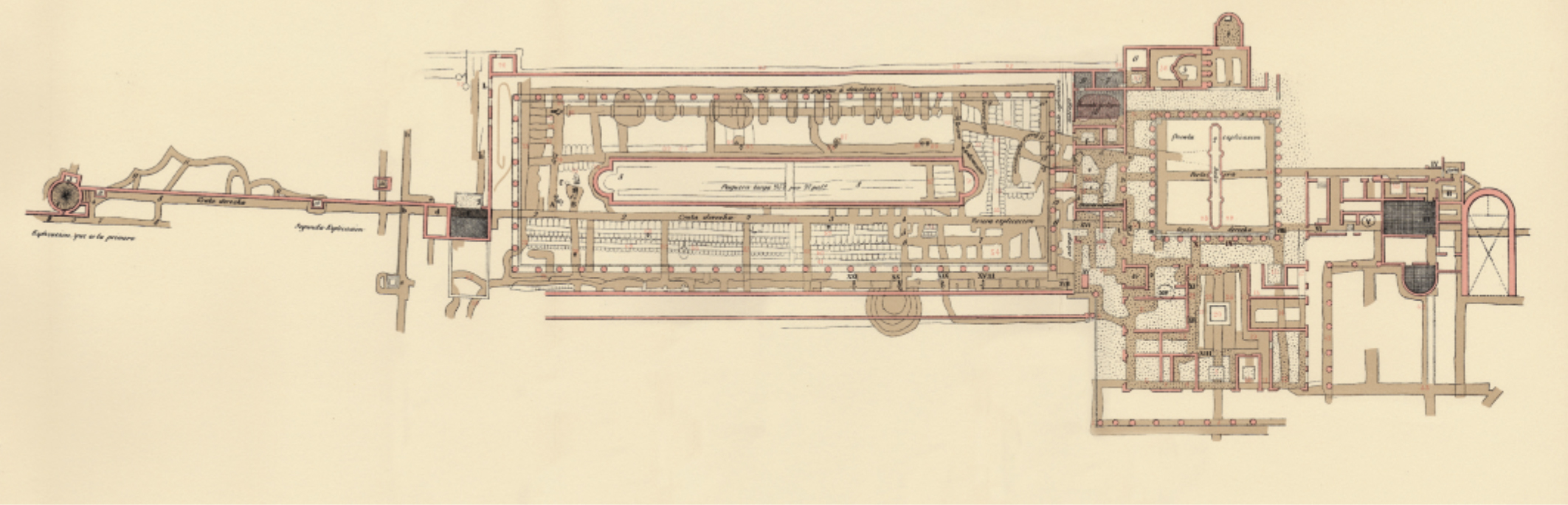
"Villa dei Papiri": mappa redatta dall'ingegnere militare Karl Weber durante i primi scavi nel XVIII secolo e ridisegnata da Comparetti e De Petra nel 1883 (da Zarmakoupi 2010, pl. 1, fig. 1)

Luoghi di ritrovamento dei papiri all'interno della villa (da Zarmakoupi 2010, pl. 13, fig. 26)
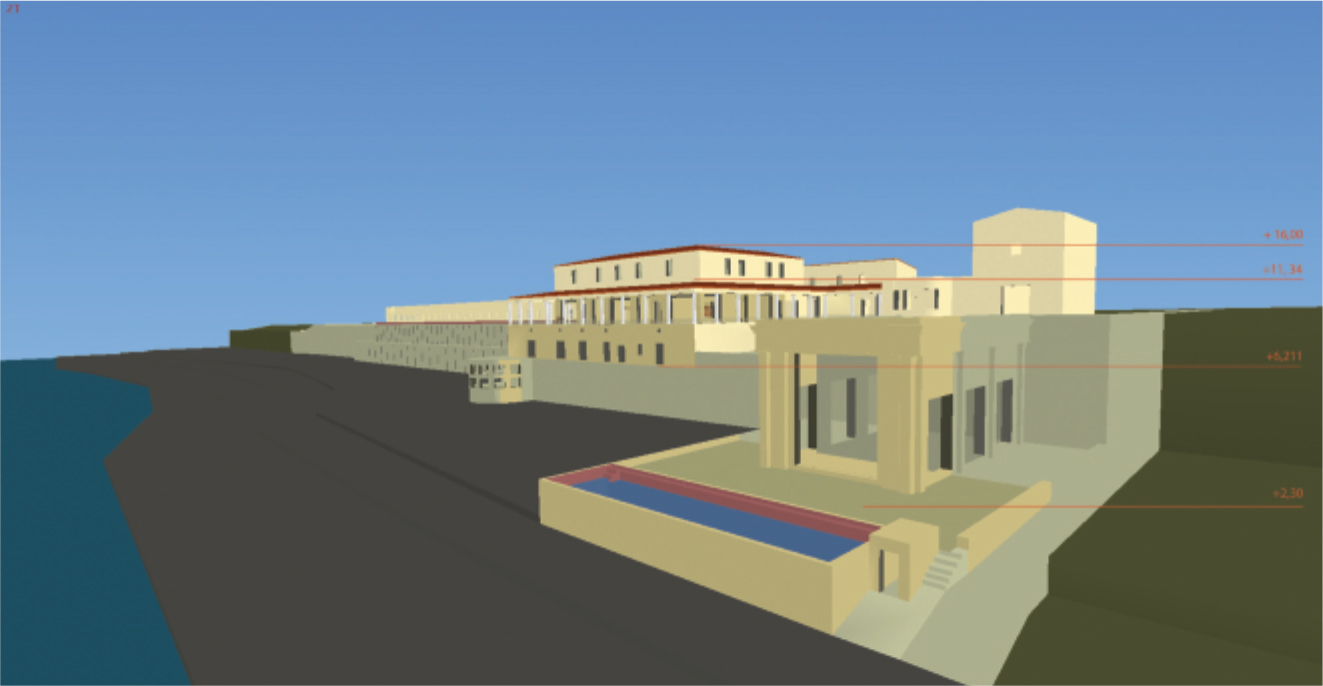
"Villa dei Papiri": ricostruzione virtuale (da Zarmakoupi 2010, pl. 69, fig. 4)
About the author
Francesco Cannizzaro -
Università degli studi di Firenze
Informations
Cita come: Francesco Cannizzaro, The "Villa of the Papyri" Library in Herculaneum_Scheda Letteraria, anno 2023, DOI 10.35948/DILEF/Dalib/16 contenuto in Valeria Piano, Barbara del Giovane (a cura di), DaLiB. Dal Libro alla biblioteca, DILEF Unifi 2023.
Ricevuto il: 12/07/2023
Pubblicato online il: 28/09/2023
DOI: 10.35948/DILEF/Dalib/16
Copyright e licenza d'uso: https://dalib.it/contenuti/informativa/8261
Progetto finanziato da: