- Original paper
- Open access
The Libraries of Pliny the Younger (and Their Relationship with the Books of Pliny the Elder)
Fa parte di Biblioteche private/Altre biblioteche private di area occidentale
Marta Maria Perilli - Pubblicato online il 28/09/2023 - DOI: 10.35948/DILEF/Dalib/22
Description
In his letters, Pliny the Younger speaks both of his works, often with regard to their composition, writing and reception, and of the books in his possession. While we have a fair amount of information enabling the identification of at least some of the titles in his book collection, the information about where the books were kept is much more scarce. Among Pliny the Younger’s various properties,[1] the only one explicitly mentioned as having a space set aside for storing books is the Laurentine villa, near Ostia. From the description of the villa and the works present there, it emerges that this was however not Pliny’s main library. Even though there is no explicit testimony of this, it is reasonable to suppose that his house on the Esquiline in Rome was where – as Martial also attests – Pliny the Younger definitely received books and probably stored them too.
Misenum, where the presence of some books belonging to Pliny the Elder can perhaps be hypothesized, is a case apart. When he was there in Campania with the Elder Pliny in 79 CE, the Younger Pliny set down to study a book by Livy. Furthermore, the Elder Pliny’s works must have made up no small part of the Younger Pliny’s book collection. Nevertheless, the sources in our possession only allow a partial reconstruction of Pliny the Elder’s bequest to his nephew, consisting only of the works written by the former.
The Laurentine Villa, the “Library” and Its Books
Pliny himself gives information as to the location of the Laurentine villa:[2] it was seventeen miles from Rome and one got there along the Via Laurentina, which had to be left at the fourteenth milestone, or along the Via Ostiensis, which had to be left at the eleventh milestone (paragraphs 1-2 in Plin. epist. 2, 17). It was situated on the coast near Ostia, in an area of villas, and it was close to a village with three public baths. Just one villa separated Pliny’s dwelling from the village (paragraphs 26-27 in Plin. epist. 2, 17). The village is generally identified as the uicus Augustanus, situated around five miles to the south of Ostia, in what is now Castelporziano.[3] The location of the Laurentine villa, on the coast near Ostia, can be narrowed down based on what Pliny writes. Nevertheless, its exact position remains uncertain. To date, two possible sites have been proposed: the so-called “Villa Magna” in Grotte di Piastra, inside the present-day presidential estate of Castelporziano, and the site known as “Pliny’s villa” (“la Palombara”), today in the Castel Fusano public gardens (see BIBPLIN-AR).[4]
Pliny mainly spent his time in the Laurentine villa in otium studiosum (Plin. epist. 1, 22, 11): studying, reading and writing (Plin. epist. 1, 9, 4-6; Plin. epist. 1, 22, 11; paragraphs 8 and 24 in Plin. epist. 2, 17; Plin. epist. 4, 6, 1-2; Plin. epist. 7, 4, 1-9). Indeed he considered it his μουσεῖον, “Temple of the Muses” (par. 6 in Plin. epist. 1, 9, 4-6), a place dedicated to literature, perhaps in an allusion to the Museum of Alexandria.[5] Pliny also stayed there during the winter months (Plin. epist. 9, 40, 1-2), when Rome was bustling with court and senate activities. Indeed, the villa’s proximity to the capital meant that Pliny could retire there by nightfall after he finished his appointments in Rome (par. 2 in Plin. epist. 2, 17). While its main purpose was for moments of otium, the Laurentine villa was a place where negotia could nevertheless take place. Whenever some legal duty arose, as often happened in the winter months (si agendi necessitas instat, quae frequens hieme), there Pliny could get down to revising and correcting the speeches to make during the trials that were held in the capital (Plin. epist. 9, 40, 1-2).
Pliny makes hardly any mention of the decorative elements or furnishings in the villa or his other properties.[6] However, he does describe a semicircular room in the winter quarters with a cupboard (armarium) in the wall functioning “as a library” (in bybliothecae speciem), housing books not just for reading, but for repeated consultation (par. 8 in Plin. epist. 2, 17).[7] This last detail suggests that the books were probably for study and above all a select collection.[8] Going by what Pliny says, therefore, there was no space structured as a library, but simply a room set aside for storing some texts.[9] Furthermore, the writings that Pliny had the time to produce during his stays in the villa were placed in a wooden chest (scrinium; Plin. epist. 4, 6, 1-2):[10] considering the type of container, which was also suitable for transporting books, Pliny may have taken his works with him when he left his out-of-town house.
The only work which is explicitly mentioned as being present in the villa is the several-volume anti-Ciceronian work (the so-called De comparatione patris et Ciceronis) by Asinius Gallus, son of Asinius Pollio,[11] which quotes an erotic epigram written by Cicero about Tiro (par. 3 in Plin. epist. 7, 4, 1-9).[12] In letter 7, 4, Pliny relates that reading Cicero’s epigram in the Laurentine villa led him to try his hand at composing hendecasyllabic verse (paragraphs 1-6 in Plin. epist. 7, 4, 1-9), quoting a hexametric composition he had written as a result, in which he paraphrases Cicero’s epigram (par. 6 in Plin. epist. 7, 4, 1-9).[13] Pliny followed this by composing elegiac verse and verse in various other metres, which he read to friends in Rome, receiving – it would seem – praise. Therefore, he decided to collect his hendecasyllabic poems in a single book (paragraphs 7-9 in Plin. epist. 7, 4, 1-9), which he sent to his friend Paternus, telling him that he had called it Hendecasyllables (Plin. epist. 4, 14, 1-9).[14] Given that not all the judgements of his book of poems from its readers were positive, in letter 5, 3 Pliny defends both the book and, more generally, his choice to also write poetry, against his critics (Plin. epist. 5, 3, 1-2).[15] Pliny’s compositions were written not only in the Laurentine villa, but in a multitude of “snatched” moments: in a carriage, at the baths, during banquets as he took pleasure in moments of otium (par. 2 in Plin. epist. 4, 14, 1-9; par. 8 in Plin. epist. 7, 4, 1-9).
So, from Pliny’s testimony, we can glean that the Laurentine villa housed the work of Asinius Gallus and some texts which Pliny himself composed and revised there, as well as a certain number of works unknown to us that must have been part of that select collection housed in the armarium functioning as the villa’s library.
Given that the Laurentine villa is mentioned various times in his letters, right from Book 1 to Book 9 (Plin. epist. 1, 9, 4-6; Plin. epist. 1, 22, 11; Plin. epist. 2, 17; Plin. epist. 4, 6, 1-2; Plin. epist. 5, 2, 1; Plin. epist. 7, 4, 1-9; Plin. epist. 9, 40, 1-2), the villa’s library must have been operational for the whole time span to which the letters can be dated, that is – all debate aside – from circa 96 to 108 or 109 CE.[16] Nevertheless, this chronological range can certainly be extended. Indeed, it is plausible that Pliny inherited the Laurentine villa, like most of the other dwellings he owned, from Pliny the Elder, who died in 79 CE, the year that can conventionally be pinpointed as the start of the library’s activity in the villa. Since we have no information on the sale of the property, in all likelihood this period can be extended until Pliny’s death, just after 111 or in 112 CE.
The House on the Esquiline
The concordant testimonies of Martial and Pliny himself allow us to pinpoint another place where it seems highly probable Pliny the Younger had a library. As Martial’s patron,[17] Pliny received at least Book 10 of the Epigrams from the poet. In the dedicatory composition (Mart. 10, 20), the poet shows the Muse Thalia the route to follow in order for the book to get to Pliny’s house in Rome, where he is described as busy getting speeches ready for the centumviral court (a laudatory note comparing Pliny with Cicero). In the letter written on occasion of Martial’s death (Plin. epist. 3, 21), Pliny refers to the verses that the poet had dedicated to him (also quoting them in part) and specifies that the book had been sent to his townhouse on the Esquiline (par. 5 in Plin. epist. 3, 21).[18] On the basis of the topographical indications given by Martial and Pliny, we can infer that the house must have been situated to the east of the Porticus Liuiae, close to the present-day Piazza San Martino ai Monti.[19]
Pliny never describes his house in Rome, hence he never allows us a glimpse of its library. Nevertheless, we can most likely suppose that his main library, the one where he kept the various works in his possession and which he used for his oratory, political and literary career in Rome, was found in this dwelling. Were this the case, it was a library of a certain size which could have held works he received from his peers, for example, works inherited from Pliny the Elder (on which see infra), and various “classics” of Greek and Latin literature which Pliny would have possessed, but of which we do not have explicit testimony. Indeed, the only testimony we have about the library in his Roman townhouse is the presence of Martial’s book.
As far as the chronology of this house and its book collection is concerned, the dates at our disposal are 98 CE, the year of publication of Book 10 of Martial’s Epigrams, and the period between 101 or 102 and 104 CE, the date of Pliny’s letter 3, 21.[20] In any case, the date of Pliny’s letter carries less weight, given that it looks back at an episode, namely Martial’s death, that happened at least three years earlier. Nevertheless, the considerations made about the Laurentine villa hold (see above): the dwelling on the Esquiline could also have been part of the inheritance from Pliny the Elder and, since we have no information on its sale, it can be supposed that it remained the property of Pliny the Younger until his death.
Further Testimonies of Pliny the Younger’s Book Collection
Among Pliny’s dense network of contacts with friends and more or less illustrious men of letters, it was customary to exchange works as well as provide opinions on them and correct them.[21] These texts, which can probably be included in Pliny’s book collection,[22] notably include the books of Tacitus.[23]
Two letters testify that Pliny received some of the volumes of the Historiae from Tacitus (Plin. epist. 7, 20, 1-3; Plin. epist. 8, 7).[24] In the first of the two letters, Pliny states that he had read the book he received with the utmost attention and noted down his observations (par. 1 in Plin. epist. 7, 20, 1-3); in the second he asserts his intention to do the same with another book sent to him by Tacitus (Plin. epist. 8, 7). In all likelihood, they are two distinct books from Tacitus’ work, given that the letters seem to be written in different circumstances: in the first letter Pliny says that he had in turn sent one of his own books to Tacitus and that he was looking forward to receiving his comments (par. 2 in Plin. epist. 7, 20, 1-3); whereas in the second, Pliny says that on this occasion he would not be sending any of his works to his correspondent (Plin. epist. 8, 7).[25] Since Tacitus’ annotated books will have been returned to the sender so that he could read Pliny’s observations, it is legitimate to suppose that, once published, Pliny would have received a copy.
Suetonius is another of Pliny’s most well-known correspondents.[26] The letters do not explicitly mention an exchange of books between the two, but in one Pliny urges Suetonius to publish one of his works (perhaps De uiris illustribus),[27] so that it could be copied, read and sold, that is, enter the book circulation channels as soon as possible.[28] Pliny informs us that he himself had promoted the book among his circle of friends, composing some hendecasyllables to herald its publication (Plin. epist. 5, 10).[29] The letter does not reference Suetonius’ work coming to Pliny but – like Tacitus’ work – it is hard to imagine that Pliny did not come into possession of it at some stage of its composition or once it had been published.
Pliny the Elder’s Book Bequest
Pliny the Younger’s book collection probably included the Elder Pliny’s books. Indeed, Pliny must have inherited what was certainly the very vast book collection of his uncle and adoptive father, Pliny the Elder,[30] who died when Vesuvius erupted in 79 CE. While we do not have any explicit evidence as to what happened to the works that had belonged to Pliny the Elder, we can nevertheless glean some information on the fate of his authored works and their bequest to his nephew.
In letter 3, 5, Pliny provides a list of all Pliny the Elder’s works, indicating how many books each one comprised (paragraphs 1-6 in Plin. epist. 3, 5):[31] De iaculatione equestri unus (“Throwing the Javelin from Horseback” in one book); De uita Pomponi Secundi duo (“Life of Pomponius Secundus” in two books); Bellorum Germaniae uiginti (“The German Wars” in twenty books); Studiosi tres (“The Scholar” in three books, each divided into two rolls and totalling six uolumina); Dubii sermonis octo (“Of Doubtful Phraseology”, in eight books); A fine Aufidi Bassi triginta unus (“Continuation of the History of Aufidius Bassus” in thirty-one books); Naturae historiarum triginta septem (“Natural History” in thirty-seven books). The works are cited in chronological order of composition and are mostly accompanied by a description of the circumstances or the reason for their composition along with a mention of their contents.[32]
Pliny compiled this catalogue in response to Baebius Macer’s request[33] for a complete list of the works by Pliny the Elder, of whom he was an enthusiastic reader, so he could get his hands on all of them (par. 1 in Plin. epist. 3, 5). Given that the list was made for this specific purpose, the works mentioned must have been in circulation and available on the market.[34] As well as underlining the length of the treatise, Pliny’s indication of the number of uolumina into which the three books of “The Scholar” were divided can be seen as his making sure that Baebius Macer obtained the whole work (par. 3 in Plin. epist. 3, 5).[35] Furthermore, this availability of the elder Pliny’s literary works leads to another consideration: at the time of letter 3, 5, Pliny the Younger must have completed his uncle’s task of posthumously publishing “Continuation of the History of Aufidius Bassus”, a historical work that presumably dealt with the events following the death of Claudius until 71 CE.[36] In the preface of the Naturalis Historia, published in 77 CE and dedicated to Titus, Pliny the Elder says that he had already completed the “Continuation” but decided not to have it circulate while he was still alive, instead entrusting its publication to his heir. Indeed, he feared that the work would result in accusations of social climbing, probably because he celebrated the Flavians in fawning tones (Plin. nat., praef. 20).[37]
Thus, Pliny the Younger must have had at his disposal all of the Elder Pliny’s books mentioned in the letter to Baebius Macer. This can be inferred from the amount of detail he uses to describe them and provide the list,[38] from his bond with his uncle, and above all from the vicissitudes of the publication of Pliny the Elder’s historical work. As stated at the end of the letter (par. 20 in Plin. epist. 3, 5), they were books that Pliny the Elder had left (reliquisset) after his death: the verb relinquo can be understood in a general sense, referring to his bequest to posterity, and in a more specific sense, referring to his bequest to Pliny the Younger, his nephew and heir.
Letter 3, 5 also illustrates Pliny the Elder’s untiring commitment to his studies and to writing,[39] which translated into his constant annotation and transcription of passages from the works that he read or were read to him (paragraphs 10-11 and 14-15 in Plin. epist. 3, 5). The upshot of this work was 160 opisthographic volumes, packed with small script, of commentarii. These collections of excerpts of the works that had been read, probably rehashed in part with the addition of personal notes, formed the preparatory material for the final draft of his own works.[40] Unlike the titles listed in the first part of the letter, Pliny explicitly states that he had inherited this enormous mass of volumes, of no mean economic value (par. 17 in Plin. epist. 3, 5). Indeed, it is specified that when Pliny the Elder was procurator of Hispania Tarraconensis (around 72-74 CE),[41] he could have sold them to Larcius Licinus,[42] governor of the province, for 400,000 sesterce: given that at that point in time there were fewer volumes of commentarii than what Pliny had inherited in 79 CE, the value of all 160 volumes would have been greater than the figure offered by Larcius Licinus.
The nature of these writings, definitely not put together for publication, and their exclusion from the list of Pliny the Elder’s works which Baebius Macer could have accessed, leads us to infer that the commentarii were not in circulation and that Pliny the Younger kept them for his personal use in one of his houses, perhaps in Rome.[43] For this same reason, the hypothesis that they were left to the library of Comum has to be ruled out (see BIBCOMO-LET).[44]
Reading Livy in Misenum: A Library of Pliny the Elder?
At the time of the eruption of Vesuvius in 79 CE, the subject of the famous letters 6, 16 and 6, 20,[45] Pliny the Younger was with his mother and uncle in Misenum, the base of the Empire’s western fleet, in which Pliny the Elder held the role of admiral (par. 4 in Plin. epist. 6, 16).[46] The domus where they were staying was next to the beach and close to other houses (paragraphs 4 and 6 in Plin. epist. 6, 20).[47] Considering the perspective from which Pliny the Elder had the possibility of observing the cloud of smoke rising from Vesuvius (par. 4-5 in Plin. epist. 6, 16), it has been suggested that the house was situated in the northern part of Cape Misenum, in the Punta Sarparella area, not far from the Roman theatre of Misenum and the Sanctuary of the Augustales, currently in Via Sacello di Miseno (image 3).[48] When Pliny the Elder decided to set sail towards the place of the eruption to observe the natural phenomenon from close up and take aid to the people who lived in the areas closer to the Vesuvius, Pliny the Younger decided not to go with him. He wanted to carry on studying, continuing the task entrusted to him by his uncle (par. 7 in Plin. epist. 6, 16; par. 2 Plin. epist. 6, 20): reading Livy and transcribing passages from the work (par. 5 in Plin. epist. 6, 20).[49]
The book by Livy probably belonged to Pliny the Elder, but it cannot be established whether it was part of a library of his permanently present in Misenum. Indeed, we do not know if the volume was already there when Pliny the Elder arrived with his nephew or if it had been taken there for their stay in the Campanian town. Furthermore, it is not clear if the house in Misenum was owned by Pliny the Elder or if it was a lodging made available to him as admiral of the fleet. If we assume that Livy’s volume was part of a collection (probably quite a small one) kept in Misenum – whether the house belonged to Pliny the Elder or it was a place he held in usufruct, he could nevertheless have kept some books there – this information could suggest that there was a small, secondary library of Pliny the Elder in Misenum. In any case, it indicates that books were disseminated in the various places where the members of the imperial Roman elite sojourned.
We do not know what happened to Livy’s book: whether it stayed in Misenum or was taken away to then become part of Pliny the Younger’s book collection. Besides, Misenum is not mentioned anywhere else in the letters, which generally make very few references to Campania.[50] While this house, with its possible library, seems to have been connected to Pliny the Elder and his nephew’s intense study and exchange of books up to 79 CE, after that it does not seem to have played an important role in the life and literary engagement of Pliny the Younger.
On the villas and properties of Pliny the Younger, see Duncan-Jones 1965; Mansuelli 1978; De Neeve 1990, pp. 369-372; Bergmann 1995, esp. pp. 406-407; Maselli 1995; Anguissola 2007 (with further bibliography ); Re 2021, pp. 136-145; Gibson – Morello 2012, pp. 200-233. Additional bibliography in Gibson – Morello 2012, pp. 297 and 306-307 and Marchesi 2015, p. 231 n. 4. On Pliny’s “villa life” and the textual and intertextual strategies adopted in the descriptions of the villas, see recently Re 2021, pp. 146-180; Canobbio 2022; 2023; Chinn 2023 (also on the descriptions of villas in Statius). ↑
On the Laurentine villa, in particular as a place for literary activities, see Förtsch 1993, pp. 26-29; Leach 2003, pp. 154-156; Mielsch 2003; Riggsby 2003; Myers 2005, pp. 111-123; Gibson – Morello 2012, pp. 211-232; Marchesi 2015, pp. 232-240; Gibson 2020, pp. 132-139 and 144-148; Re 2021, pp. 141-144. For a commentary on Pliny’s letter 2, 17, see Sherwin-White 1966, pp. 186-199; Whitton 2013, pp. 218-255; archaeological commentary in Lehmann-Hartleben 2007, pp. 43-49. ↑
For an overview of the studies on the uicus Augustanus, see Gibson – Morello 2012, p. 231; Whitton 2013, pp. 251-252. ↑
On identifying the position of the Laurentine villa, the excavation history and attempts at locating it, see Förtsch 1993, pp. 18-22; Bergmann 1995, pp. 406-407, esp. p. 407 n. 5 (with extensive bibliography); Gibson – Morello 2012, pp. 226 and 230-232, esp. p. 230 n. 104. On the litus Laurentinum, see Purcell 1998. On the excavation at Pliny’s villa in Castel Fusano and at the Villa Magna in Castelporziano, see Marzano 2007, pp. 309 and 315 (with reproductions on pp. 308 and 314). ↑
See Tamás 2023, p. 238, who also compares it to the Horti Maecenatis. ↑
Several explanations have been given for this reticence: the desire to avoid potential moralistic criticism against luxury objects and furnishings (Hoffer 1999, p. 29); Pliny’s primary wish to provide a portrait of his persona and occupations not “overshadowed” by further material details (Gibson – Morello 2012, pp. 216-217); a strategic move to transport the villas into an atemporal dimension by removing any “datable” element or object from the description (Canobbio 2022, p. 172). For an analysis of this topic comparing Pliny and Martial’s different attitudes both towards “everyday objects” and towards their respective literary works, see Marchesi 2015. ↑
On the armarium to house the books, see Petrain 2013, pp. 336-338 (specifically p. 337 n. 20); Houston 2014, pp. 184-188 (on this passage in Pliny, see specifically pp. 187-188). On the various types of cubiculum in the descriptions of Pliny’s villas, see Förtsch 1993, pp. 54-56. ↑
Whitton 2013, p. 233. ↑
In contrast, see in letter 4, 28 the description of the library of Herennius Severus, with its decorative elements: see BIBERSEV-LET. ↑
On this type of container for books, see Houston 2014, pp. 181-183; see LIBOCC-LET: “The Tabernae librariae”. ↑
According to what is relayed by Suetonius (Claud. 41), the emperor Claudius wrote a “Defence of Cicero Against the Writings of Asinius Gallus”. Another voice in favour of Cicero and against the writings of Asinius Gallus was Gellius (17, 1, 1). Asinius Pollio and Asinius Gallus’ aversion against Cicero’s oratory is mentioned by Quint. inst. 12, 1, 22. On the issue and with reference to the work of Asinius Gallus, within the framework of the reception of Cicero’s oratory in the early imperial age, see Degl’Innocenti Pierini 2003, pp. 7-12 (esp. p. 7 n. 22); La Bua 2019, pp. 112-113 (with bibliography). On Asinius Gallus, see Danesi Marioni 2001. ↑
The authenticity of Cicero’s epigram is disputed. It is denied, among others, by Soubiran 1972, pp. 67-68 and 298 and is deemed dubious by Blänsdorf 20112, p. 158 and Courtney 20032, pp. 367-368, who discusses it in the ambit of Pliny’s poetic fragments. Its authenticity is instead defended by Malaspina 1999 (with exhaustive bibliography on the previous debate) and Morelli 2000, pp. 180-181. ↑
On Pliny’s poetry, see Hershkowitz 1995; Auhagen 2003; Marchesi 2008, pp. 57-88; Gibson – Steel 2010, pp. 125-137; Canobbio 2015 (with bibliography); Edmunds 2015. For a framing within the genre of “minor” contemporary poetry, especially in relation to the poetry of Martial and Statius, see Citroni 2004 and Aricò 2008. In particular on the composition cited in par. 6 of Plin. epist. 7, 4, 1-9, in relation to the poetry of Cicero, see Mattiacci 2016, pp. 129-132. Two more poems by Pliny have come down to us in addition to this one. One is found in Plin. epist. 7, 9, 11 and one in the Anthologia Latina (710 Riese): see Blänsdorf 20112, pp. 335-337; Courtney 20032, pp. 367-370. ↑
Canobbio 2015, pp. 189-190 considers Plin. epist. 4, 14 a missive accompanying the book of poetry, having similar functions to the prefatory letters of the books of Martial and of Statius’ Siluae. ↑
On the letters’ various references to Pliny’s poems, see Sherwin-White 1966, p. 289. He speaks of the book in hendecasyllables in epist. 4, 14; 5, 3; 7, 4 (quoted below) and of the publication of a second book of poems with new compositions in different metres in epist. 8, 21. There are other references to his verse in epist. 4, 19, 4; 4, 27, 3; 7, 9, 10-14; 9, 10 (addressed to Tacitus); 9, 16; 9, 25; and 9, 34 (addressed to Suetonius) and to an attempt to emulate and translate some Greek compositions by Arrius Antoninus into Latin in epist. 4, 18 and 5, 15 (on Arrius Antoninus, see Gibson – Morello 2012, p. 127 n. 174). Furthermore, see Plin. epist. 5, 10, in which Pliny says that he promoted a work by Suetonius with his hendecasyllables (on this see infra). ↑
For a summary of the debate over the chronology of Pliny’s letters, see Sherwin-White 1966, pp. 27-41; Gibson – Morello 2012, p. 266; Vannini 2019, xiv-xvi, with bibliography. For a new examination of the question, see Bodel 2015. ↑
On Pliny as Martial’s patron, see Nauta 2002, pp. 37-39; 142-144; 147-148; Canobbio 2015, pp. 191-193. For some observations on Pliny as a patron, in a more general study on the concept of amicitia in Pliny, see Castagna 2003. ↑
On the relationship between Martial’s epigram 10, 20 and Pliny’s letter 3, 21, see Marchesi 2008, pp. 65-67; Gibson – Morello 2012, pp. 88-89; Tzounakas 2013; Gibson 2020, p. 110; on the intertextual references between the two texts, see Marchesi 2013 (with bibliography to date on p. 102 n. 3); Neger 2015; additional bibliography in Whitton 2019, p. 107 n. 173. For a detailed comment on Mart. 10, 20, see Buongiovanni 2012, pp. 71-121. ↑
Gibson 2020, p. 257. The activities described in other letters presuppose that Pliny was in his house in Rome, but only letter 3, 21 explicitly mentions the dwelling on the Esquiline: see Gibson – Morello 2012, p. 204, esp. n. 10 with additional bibliography; Gibson 2020, p. 257. ↑
Sherwin-White 1966, pp. 262-263. ↑
Letter 4, 26 is an interesting case. In it Pliny accepts to correct the text of some of his own works which a friend had acquired on the book market, hence attesting to the circulation of copies with mistakes and the value of author corrections (the letter is discussed and quoted in BIBGMART-LET: “The Library of the Villa on the Ianiculum”; LIBOCC-LET: “Booksellers and the Circulation of Texts”). On Pliny’s circle of acquaintances, see White 1975, pp. 293-300 (esp. p. 299 n. 50); Gibson – Morello 2012, pp. 136-147. Observations on some of these friends are also made in Castagna 2003 (with bibliography to date). On exchanges of works and requests for corrections or opinions in Pliny, see Delvigo 1990, pp. 98-99; Nauta 2002, p. 124; Merli 2010, pp. 85-89; 2013, pp. 154-158. The custom in Martial is different. His requests for corrections are a formula of respect to the dedicatee of the book and do not presuppose that the text will actually be corrected: see BIBGMART-LET: “The House in the Campus Martius and Martial’s Other Books” (with bibliography in n. 17). ↑
In addition to the works of Tacitus (on which see infra), Pliny also says that he received works from other men of letters, on which for the main part we have no proposographic information, in epist. 3, 15; 4, 20; 9, 8; 9, 35. As well as this, he urged Caninius Rufus to send him his as-yet-unfinished historical poem on Trajan’s triumph over the Dacians in epist. 8, 4 (on the series of letters to Caninius Rufus, see Canobbio 2023, specifically pp. 197-198). For an overview of the letters in which Pliny sends one of his works to friends and asks them for their opinions or corrections, see Merli 2013, p. 157 n. 7, as well as epist. 6, 33. Furthermore, on letter 1, 8, in which Pliny sends Pompeius Saturninus the text of the speech made during the inauguration of the library in Comum, see BIBCOMO-LET. ↑
Of the recent works on the relationship between Pliny the Younger and Tacitus, see Marchesi 2008, pp. 97-143 (esp. pp. 135-143 on letter 7, 20); Gibson – Morello 2012, pp. 135 and 161-168 (with bibliography on pp. 304-305); Whitton 2012 (with bibliography on pp. 364-365). For a list of Pliny’s eleven letters addressed to Tacitus, see Gibson 2020, p. 118 n. 37 (on epist. 4, 13 see BIBCOMO-LET). Of the letters to Tacitus, the ones on the eruption of Vesuvius are particularly indicative of the literary exchanges between the two (epist. 6, 16 and 6, 20). These were written by Pliny to respond to Tacitus’ request for a report of what had happened, which the historian could use for his description of the event (see infra). ↑
The letters are dated 106-107 CE (Sherwin-White 1966, p. 426). Pliny does not explicitly say which of Tacitus’ works he received, but the most strongly supported hypothesis is that it was the Historiae: see Sherwin-White 1966, p. 427 (also on the previous debate, with bibliography and considerations on the dating of the Historiae). ↑
Sherwin-White 1966, pp. 427 and 456. ↑
Pliny’s letters relating to or sent to Suetonius are letters 1, 18; 1, 24; 3, 8; 5, 10; 9, 34; 10, 94. On this series of letters, with hypothesis of the relative chronology, see Méthy 2009. ↑
Its – probable but not incontrovertible – identification as the De uiris illustribus has recently been upheld, among others, by Power 2010, pp. 140-156 (also on the dating of the work by Suetonius); Gibson – Morello 2012, p. 222; Gibson 2014, pp. 202-203; Canobbio 2018. For a broad review of the bibliography to date for or against this hypothesis and of the studies that have suggested alternative hypotheses, see Power 2010, pp. 141-142 n. 7 and Canobbio 2018, pp. 52-58. ↑
See LIBOCC-LET n. 33. On the exhortations to publish aimed at various of Pliny and Martial’s writer friends, see Merli 2013, pp. 124-127; Citroni 2015, pp. 111-112 (with collections of passages). On the variation of this pattern in the case of Stertinius Avitus, Martial’s patron who forgoes publishing his poems, see BIBSTERTAV-LET and n. 3. ↑
On the poetry of Pliny, see above. On the hendecasyllables about Suetonius’ work, see n. 15. ↑
See Plin. epist. 5, 8, 5. On book collections left in wills, see Houston 2014, pp. 30-31 (furthermore, p. 26 on the passage of Pliny the Elder’s books to Pliny the Younger). ↑
The English translations of the titles of the works by Pliny the Elder are taken, with minor adjustments, from Betty Radice’s translation of Pliny’s Letters for Loeb. ↑
For a synoptic table of Pliny the Elder’s works and Pliny the Younger’s comments on each one of them, see Gibson 2011, pp. 196-197. The Naturalis Historia is the only one on which Pliny the Younger expresses an aesthetic judgement (Citroni Marchetti 2011, pp. 97-99). On the characterization of Pliny the Elder through the list of his works in letter 3, 5 and on the description of his actions in letter 6, 16 (on which see infra), see Citroni Marchetti 2011, pp. 56-58; 100-102; Gibson 2011, pp. 195-205; furthermore, Henderson 2002a, pp. 68-102. ↑
On Baebius Macer, consul in 103 CE (Plin. epist. 4, 9, 16), see Sherwin-White 1966, pp. 215-216; Birley 2000, p. 41 (with bibliography). For useful reflections on the relationship between the readers and works of Pliny the Elder starting from the figure of Baebius Macer, see Citroni Marchetti 2011, pp. 72 ff. ↑
On the book trade, see LIBOCC-LET. ↑
Pecere 2010, p. 158 observes that, in this as in other cases, the division of the work into distinct rolls depends on the author, who “in view of the publication, divides the work into books in light of the subject-matter” (own translation). ↑
For a hypothesis of the contents and tone of the work, with additional bibliography, see Sherwin-White 1966, p. 218; Ash 2011, p. 4 n. 12; Citroni Marchetti 2011, p. 58 n. 3. ↑
Ash 2011, p. 3 n. 11; Citroni Marchetti 2011, pp. 58-59. For an analysis of the reasons that could explain Pliny the Younger’s reticence concerning Pliny the Elder’s historical work in letter 3, 5, compared to the emphasis placed on this very same work in the preface of the Naturalis Historia, see Gibson2011, pp. 197-204. ↑
According to Dix 1996, p. 100 n. 13. ↑
As attested by Plin. nat., praef. 18 and Plin. epist. 3, 5, 8-9, Pliny the Elder also devoted himself to literary pursuits at night, given that daytimes were taken up by his various public commitments at the Flavians’ service. On the topic of “working at night” in Pliny the Elder, with its literary and political implications, see Citroni Marchetti 2011, pp. 32-48; on the differences from Pliny the Younger’s work method, see Cova 2001, pp. 58-59 and 64-66; Hindermann 2023, pp. 142-146. ↑
On Pliny the Elder’s work method and the collections of extracts, see Dorandi 2007, pp. 30-37 (with bibliography to date); furthermore, Henderson 2002a, pp. 80-89; 2002b, pp. 272-273; Pecere 2010, pp. 154-155; Conte 20122, pp. 77-79; Houston 2014, pp. 26-28. ↑
Vannini 2019, p. 193 n. 15. ↑
PIR2 L 95. On this attempted purchase and the sale of several books or private book collections “en bloc”, see Houston 2014, pp. 28-30. ↑
Citroni Marchetti 2011, pp. 57-58 notes that letter 3, 5 describes Pliny the Elder’s commentarii as “withdrawn from possible sale and closed off in a family legacy, […] with the impression that it was substantially impossible to read them” (own translation). ↑
As instead hypothesized by Dix 1996, pp. 89 and 100 n. 13. ↑
The two letters are addressed to Tacitus (on whom see above). For the bibliography on these letters, see Anguissola 2007; Gibson – Morello 2012, p. 306; Gibson 2020, pp. 52-85, with an analysis of the two texts. A recent volume by Foss 2022 proposes a new examination of the two letters and the eruption of Vesuvius in 79 CE through an interdisciplinary approach combining philology, archaeology and volcanology. ↑
On the fleet berthed in Misenum, see Starr 19833, pp. 13-16; D’Arms 2003, pp. 85-87; 135. ↑
Lehmann-Hartleben 2007, p. 11; Foss 2022, p. 228. ↑
The issue has recently been re-examined by Foss 2022, pp. 134-135 (with bibliography to date on p. 164 n. 93): the coordinates proposed by Foss to geolocalize the domus in Misenum are adopted in the DaLiB map; furthermore, see Gigante 1989, pp. 39-40; Gibson 2020, pp. 56; 259 (additional bibliography on p. 77 n. 17). ↑
Gibson – Morello 2012, pp. 113; Gibson 2020, pp. 57-58. For an analysis of the parallels and differences between the behaviours of Pliny the Elder and Pliny the Younger during the eruption of Vesuvius, see Cova 2001, pp. 55-58. With particular attention to the central importance of studia in these circumstances too, see Gibson –Morello 2012, pp. 110-115; furthermore, Marchesi 2008, pp. 174-175. ↑
See Gibson 2020, pp. 54-55. ↑
Bibliography
Anguissola, A. (2007), L’epistolario di Plinio il Giovane tra letteratura e archeologia: aggiornamento bibliografico (1936-2006), in Lehmann-Hartleben, K., Plinio il Giovane. Lettere scelte con commento archeologico, Pisa (ristampa con Introduzione di P. Zanker e Aggiornamento bibliografico a cura di A. Anguissola dell’ed. Lehmann-Hartleben, K., Plinio il Giovane. Lettere scelte con commento archeologico, Firenze 1936), pp. non numerate.
Aricò, G. (2008), Leues libelli. Su alcuni aspetti della poetica dei generi minori da Stazio a Plinio il Giovane, «CentoPagine» 2, pp. 1-11.
Ash, R. (2011), Pliny the Elder’s Attitude to Warfare, in Gibson, R.K. – Morello, R. (eds.), Pliny the Elder: Themes and Contexts, Leiden-Boston, pp. 1-19.
Auhagen, U. (2003), Lusus und Gloria – Plinius’ Hendecasyllabi (Epist. 4, 14; 5, 3 und 7, 4), in Castagna, L. – Lefèvre, E. (eds.), Plinius der Jüngere und seine Zeit, München-Leipzig, pp. 3-13.
Bergmann, B. (1995), Visualizing Pliny’s Villas, «JRA» 8, pp. 406-420.
Birley, A.R. (2000), Onomasticon to the Younger Pliny. Letters and Panegyric, München-Leipzig.
Blänsdorf, J. (20112), Fragmenta poetarum Latinorum epicorum et lyricorum praeter Enni Annales et Ciceronis Germanicique Aratea, post W. Morel et K. Büchner editionem quartam auctam curavit, Berlin-New York.
Bodel, J. (2015), The Publication of Pliny’s Letters, in Marchesi, I. (ed.), Pliny the Book-Maker: Betting on Posterity in the Epistles, Oxford-New York, pp. 13-108.
Buongiovanni, C. (2012), Gli epigrammata longa del decimo libro di Marziale, Pisa.
Canobbio, A. (2015), Echi di Marziale nell’epistola 4.14 di Plinio il Giovane, «Prometheus» 41, pp. 189-207.
Canobbio, A. (2018), Plinio il Giovane, Svetonio e un invito a pubblicare: analisi intertestuale dell’epistola 5, 10, «SIFC» 16, pp. 52-70.
Canobbio, A. (2022), La periferia come valore: le ville di Plinio il Giovane tra realtà, retorica e metaletteratura, in Bonadeo, A, – Canobbio, A. – Romano, E. (eds.), Centro e periferia nella letteratura di Roma imperiale, Pavia, pp. 163-176.
Canobbio, A. (2023), The Villa and the Monument: Horace in Pliny, Epistles 1.3, in Neger, M. – Tzounakas, S. (eds.), Intertextuality in Pliny’s Epistles, Cambridge-New York, pp. 187-199.
Castagna, L. (2003), Teoria e prassi dell’amicizia in Plinio il Giovane, in Castagna, L. – Lefèvre, E. (eds.), Plinius der Jüngere und seine Zeit, München-Leipzig, pp. 145-172.
Chinn, C. (2023), The Villas of Pliny and Statius, in Neger, M. – Tzounakas, S. (eds.), Intertextuality in Pliny’s Epistles, Cambridge-New York, pp. 200-215.
Citroni Marchetti, S. (2011), La scienza della natura per un intellettuale romano. Studi su Plinio il Vecchio, Pisa-Roma.
Citroni, M. (2004), Martial, Pline le jeune et l’identité du genre de l’épigramme latine, «Dictynna» 1, pp. 125-153.
Citroni, M. (2015), Edito e inedito, pubblico e privato: Marziale, Stazio e la circolazione dei testi scritti in età flavia, «S&T» 13, pp. 89-123.
Conte, G.B. (20122), L’inventario del mondo. Forma della natura e progetto enciclopedico nell’opera di Plinio il Vecchio, in Conte, G.B. (ed.), Generi e lettori. Lucrezio, l’elegia d’amore, l’enciclopedia di Plinio, Pisa, pp. 77-112.
Courtney, E. (20032), The Fragmentary Latin Poets, Oxford.
Cova, P.V. (2001), Plinio il Giovane contro Plinio il Vecchio, «BStudLat» 31, pp. 55-67.
D’Arms, J.H. (2003), Romans on the Bay of Naples and Other Essays on Roman Campania, Bari.
Danesi Marioni, G. (2001), All’ombra di un grande padre: Asinio Gallo in Seneca retore e in Tacito, in Bianchetti, S. (ed.), Ποίκιλμα. Studi in onore di M.R. Cataudella, La Spezia, pp. 323-331.
De Neeve, P.W. (1990), A Roman Landowner and his Estates: Pliny the Younger, «Athenaeum» 68, pp. 363-402.
Degl’Innocenti Pierini, R. (2003), Cicerone nella prima età imperiale: luci ed ombre su un martire della repubblica, in Narducci, E. (ed.), Aspetti della fortuna di Cicerone nella cultura latina. Atti del III Symposium Ciceronianum Arpinas: Arpino, 10 maggio 2002, Firenze, pp. 3-54.
Delvigo, M.L. (1990), L’emendatio del filologo, del critico, dell’autore: tre modi di correggere il testo?, «MD» 24, pp. 71-110.
Dix, T.K. (1996), Pliny’s Library at Comum, «Libraries & Culture» 31, pp. 85-102.
Dorandi, T. (2007), Nell’officina dei classici. Come lavoravano gli autori antichi, Roma.
Duncan-Jones, R. (1965), The Finances of the Younger Pliny, «PBSR» 33, pp. 177-188.
Edmunds, L. (2015), Pliny the Younger on his Verse and Martial’s non-recognition of Pliny as a Poet, «HSPh» 108, pp. 309-360.
Förtsch, R. (1993), Archäologischer Kommentar zu den Villenbriefen des jüngeren Plinius, Mainz am Rhein.
Foss, P.W. (2022), Pliny and the Eruption of Vesuvius, London-New York.
Gibson, R.K. – Morello, R. (2012), Reading the Letters of Pliny the Younger: an Introduction, Cambridge-New York.
Gibson, R.K. – Steel, C. (2010), The indistinct literary careers of Cicero and Pliny the Younger, in Hardie, Ph.R. – Moore, H. (eds.), Classical Literary Careers and their Reception, Cambridge-New York, pp. 118-137.
Gibson, R.K. (2011), Elder and Better: the Naturalis Historia and the Letters of the Younger Pliny, in Gibson, R.K. – Morello, R. (eds.), Pliny the Elder: Themes and Contexts, Leiden-Boston, pp. 187-205.
Gibson, R.K. (2014), Suetonius and the uiri illustres of Pliny the Younger, in Power, T. – Gibson, R.K. (eds.), Suetonius, the biographer: Studies in Roman Lives, Oxford-New York, pp. 199-230.
Gibson, R.K. (2020), Man of High Empire. The Life of Pliny the Younger, Oxford-New York.
Gigante, M. (1989), Il fungo sul Vesuvio, Roma.
Henderson, J. (2002a), Pliny’s Statue. The Letters, Self-Portraiture & Classical Art, Exeter.
Henderson, J. (2002b), Knowing Someone Through Their Books: Pliny on Uncle Pliny (Epistles 3.5), «CPh» 97, pp. 256-284.
Hershkowitz, D. (1995), Pliny the Poet, «G&R» 42, pp. 168-181.
Hindermann, J. (2023), The Elder Pliny as Source of Inspiration: Pliny the Younger’s Reception of the Naturalis Historia and His Uncle’s Writing by the Light of a Lamp (lucubratio), in Neger, M. – Tzounakas, S. (eds.), Intertextuality in Pliny’s Epistles, Cambridge-New York, pp. 129-146.
Hoffer, S.E. (1999), The Anxieties of Pliny the Younger, Atlanta.
Houston, G.W. (2014), Inside Roman Libraries. Book Collections and their Management in Antiquity, Chapel Hill.
La Bua, G. (2019), Cicero and Roman Education. The Reception of the Speeches and Ancient Scholarship, Cambridge.
Leach, E.W. (2003), Otium as Luxuria: Economy of Status in the Younger Pliny’s Letters, «Arethusa» 36, pp. 147-165.
Lehmann-Hartleben, K. (2007), Plinio il Giovane. Lettere scelte con commento archeologico, Pisa (ristampa con Introduzione di P. Zanker e Aggiornamento bibliografico a cura di A. Anguissola dell’ed. Lehmann-Hartleben, K., Plinio il Giovane. Lettere scelte con commento archeologico, Firenze 1936).
Malaspina, E. (1999), L’autenticità di Cic. Epigr. 3 Soubiran e le dicerie su Cicerone, Quaderni del Dipartimento di Filologia, Linguistica e Tradizione classica “A. Rostagni”, Bologna, pp. 173-196.
Mansuelli, G.A. (1978), La villa nelle Epistulae di C. Plinio Cecilio Secondo, «Studi Romagnoli» 29, pp. 59-76.
Marchesi, I. (2008), The Art of Pliny’s Letters. A Poetics of Allusion in the Private Correspondence, Cambridge-New York.
Marchesi, I. (2013), Silenced Intertext: Pliny on Martial on Pliny (on Regulus), «AJPh» 134, pp. 101-118.
Marchesi, I. (2015), Uncluttered Spaces, Unlittered Texts: Pliny’s Villas as Editorial Places, in Marchesi, I. (ed.), Pliny the Book-Maker: Betting on Posterity in the Epistles, Oxford-New York, pp. 225-254.
Marzano, A. (2007), Roman Villas in Central Italy. A Social and Economic History, Leiden-Boston.
Maselli, G. (1995), Moduli descrittivi nelle ville pliniane: percezione, animazione, concezione dello spazio, «BStudLat» 25, pp. 90-104.
Mattiacci, S. (2016), I lascivi versus di Augusto citati da Marziale e la tecnica dell’epigramma nell’epigramma, in Pieri, B. – Pellicani, D. (eds.), Si verba tenerem. Studi sulla poesia latina in frammenti, Berlin-Boston, pp. 111-132.
Merli, E. (2010), La lima e il testo da Ovidio a Marziale: poetica e comunicazione, «CentoPagine» 4, pp. 79-96.
Merli, E. (2013), Dall’Elicona a Roma. Acque ispiratrici e lima poetica nell’Ovidio dell’esilio e nella poesia flavia di omaggio, Berlin-Boston.
Méthy, N. (2009), Suétone vu par un contemporain. Les débuts de l'historien dans la correspondance de Pline le Jeune, «Gerión» 27, pp. 219-229.
Mielsch, H. (2003), Traditionelle und neue Züge in den Villen des Plinius, in Castagna, L. – Lefèvre, E. (eds.), Plinius der Jüngere und seine Zeit, München-Leipzig, pp. 317-324.
Morelli, A.M. (2000), L’epigramma latino prima di Catullo, Cassino.
Myers, K.S. (2005), Docta Otia: Garden Ownership and Configurations of Leisure in Statius and Pliny the Younger, «Arethusa» 38, pp. 103-129.
Nauta, R.R. (2002), Poetry for Patrons: Literary Communication in the Age of Domitian, Leiden.
Neger, M. (2015), Pliny’s Martial and Martial’s Pliny: The Intertextual Dialogue between the Letters and the Epigrams, in Devillers, O. (ed.), Autour de Pline le Jeune: En hommage à Nicole Méthy, Bordeaux, pp. 131-144.
Pecere, O. (2010), Roma antica e il testo. Scritture d’autore e composizione letteraria, Roma-Bari.
Petrain, D. (2013), Visual Supplementation and Metonymy in the Roman Public Library, in König, J. – Oikonomopoulou, K. – Woolf, G. (eds.), Ancient Libraries, Cambridge, pp. 237-260.
Power, T.J. (2010), Pliny, Letters 5.10 and the Literary Career of Suetonius, «JRS» 100, pp. 140-162.
Purcell, N. (1998), Alla scoperta di una costa residenziale romana: il litus Laurentinum e l’archeologia dell’otium, in Lauro, M.G. (ed.), Castelporziano III. Campagne di scavo e restauro 1987-1991, Roma, pp. 11-32.
Re, A. (2021), Ville in Plinio il Giovane, orizzonte reale o spazio ideale?, in Delvigo, M.L. (ed.), Centro e Periferia nella letteratura latina di Roma imperiale, Udine, pp. 135-194.
Riggsby, A.M. (2003), Pliny in Space (and Time), «Arethusa» 36, pp. 167-186.
Sherwin-White, A.N. (1966), The Letters of Pliny. A Historical and Social Commentary, Oxford.
Soubiran, J. (1972), Cicéron, Aratea, Fragments poétiques, Paris.
Starr, C.G. (19833), The Roman Imperial Navy, 31 B.C.–A.D. 324, Chicago.
Tamás, A. (2023), A Busy Day in Rome: Pliny, Epistles 1.9 Satirized by Horace, Satires 1.9, in Neger, M. – Tzounakas, S. (eds.), Intertextuality in Pliny’s Epistles, Cambridge-New York, pp. 219-240.
Tzounakas, S. (2013), Martial’s Pliny as quoted by Pliny (Epist. 3.21), «C&M» 64, pp. 247-268.
Vannini, G. (2019), Plinio il Giovane. 50 lettere, Milano.
White, P. (1975), The Friends of Martial, Statius, and Pliny, and the Dispersal of Patronage, «HSPh» 79, pp. 265-300.
Whitton, C. (2012), “Let us tread our path together”: Tacitus and the Younger Pliny, in Pagán, V.E. (ed.), A Companion to Tacitus, Chichester-Malden (MA), pp. 345-368.
Whitton, C. (2013), Pliny the Younger. Epistles. Book II, Cambridge.
Whitton, C. (2019), The Arts of Imitation in Latin Prose: Pliny's Epistles/Quintilian in Brief, Cambridge.
Sources
| Fonti | ||
Plin. nat., praef. 20 |
Vos quidem omnes, patrem, te fratremque, diximus opere iusto, temporum nostrorum historiam orsi a fine Aufidii. Ubi sit ea, quaeres. iam pridem peracta sancitur et alioqui statutum erat heredi mandare, ne quid ambitioni dedisse vita iudicaretur. |
|
Plin. epist. 1, 9, 4-6 |
In Laurentino meo aut lego aliquid aut scribo aut etiam corpori uaco, cuius fulturis animus sustinetur. […] Neminem ipse reprehendo, nisi tamen me, cum parum commode scribo; nulla spe nullo timore sollicitor, nullis rumoribus inquietor: mecum tantum et cum libellis loquor. O rectam sinceramque uitam! O dulce otium honestumque ac paene omni negotio pulchrius! O mare, o litus, uerum secretumque μουσεῖον, quam multa inuenitis, quam multa dictatis! |
|
Plin. epist. 1, 22, 11 |
Laurentinum meum, hoc est libellos et pugillares, studiosumque otium repetam. |
|
Plin. epist. 5, 10 |
Libera tandem hendecasyllaborum meorum fidem, qui scripta tua communibus amicis spoponderunt. Adpellantur cotidie, efflagitantur, ac iam periculum est ne cogantur ad exhibendum formulam accipere. Sum et ipse in edendo haesitator, tu tamen meam quoque cunctationem tarditatemque uicisti. […] Perfectum opus absolutumque est, nec iam splendescit lima sed atteritur. Patere me uidere titulum tuum, patere audire describi legi uenire uolumina Tranquilli mei. Aequum est nos in amore tam mutuo eandem percipere ex te uoluptatem, qua tu perfrueris ex nobis. |
|
Plin. epist. 8, 7 |
Neque ut magistro magister neque ut discipulo discipulus (sic enim scribis), sed ut discipulo magister (nam tu magister, ego contra; atque adeo tu in scholam reuocas, ego adhuc Saturnalia extendo) librum misisti. Num potui longius hyperbaton facere, atque hoc ipso probare eum esse me qui non modo magister tuus, sed ne discipulus quidem debeam dici? Sumam tamen personam magistri, exseramque in librum tuum ius quod dedisti, eo liberius quod nihil ex meis interim missurus sum tibi in quo te ulciscaris. |
|
Mart. 10, 20 |
Nec doctum satis et parum seuerum, / sed non rusticulum tamen labellum / facundo mea Plinio Thalia / i perfer: breuis est labor peractae / altum uincere tramitem Suburae. / Illic Orphea protinus uidebis / udi uertice lubricum theatri / mirantisque feras auemque regis, / raptum quae Phryga pertulit Tonanti; / illic parua tui domus Pedonis / caelata est aquilae minore pinna. / Sed ne tempore non tuo disertam / pulses ebria ianuam uideto: / totos dat tetricae dies Mineruae, / dum centum studet auribus uirorum / hoc quod saecula posterique possint / Arpinis quoque conparare chartis. / Seras tutior ibis ad lucernas: / haec hora est tua, cum furit Lyaeus, / cum regnat rosa, cum madent capilli: / tunc me uel rigidi legant Catones. |
|
Plin. epist. 3, 5 |
1 Pergratum est mihi quod tam diligenter libros auunculi mei lectitas, ut habere omnes uelis quaerasque qui sint omnes. 2 Fungar indicis partibus, atque etiam quo sint ordine scripti notum tibi faciam; est enim haec quoque studiosis non iniucunda cognitio. 3 'De iaculatione equestri unus'; hunc cum praefectus alae militaret, pari ingenio curaque composuit. 'De uita Pomponi Secundi duo'; a quo singulariter amatus hoc memoriae amici quasi debitum munus exsoluit. 4 'Bellorum Germaniae uiginti'; quibus omnia quae cum Germanis gessimus bella collegit. Incohauit cum in Germania militaret, somnio monitus: adstitit ei quiescenti Drusi Neronis effigies, qui Germaniae latissime uictor ibi periit, commendabat memoriam suam orabatque ut se ab iniuria obliuionis adsereret. 5 'Studiosi tres', in sex uolumina propter amplitudinem diuisi, quibus oratorem ab incunabulis instituit et perficit. 'Dubii sermonis octo': scripsit sub Nerone nouissimis annis, cum omne studiorum genus paulo liberius et erectius periculosum seruitus fecisset. 6 'A fine Aufidi Bassi triginta unus.' 'Naturae historiarum triginta septem', opus diffusum eruditum, nec minus uarium quam ipsa natura. […] 10 Post cibum saepe (quem interdiu leuem et facilem ueterum more sumebat) aestate si quid otii iacebat in sole, liber legebatur, adnotabat excerpebatque. Nihil enim legit quod non excerperet; dicere etiam solebat nullum esse librum tam malum ut non aliqua parte prodesset. 11 Post solem plerumque frigida lauabatur, deinde gustabat dormiebatque minimum; mox quasi alio die studebat in cenae tempus. Super hanc liber legebatur adnotabatur, et quidem cursim. […] 14 In secessu solum balinei tempus studiis eximebatur (cum dico balinei, de interioribus loquor; nam dum destringitur tergiturque, audiebat aliquid aut dictabat). 15 In itinere quasi solutus ceteris curis, huic uni uacabat: ad latus notarius cum libro et pugillaribus, cuius manus hieme manicis muniebantur, ut ne caeli quidem asperitas ullum studii tempus eriperet; qua ex causa Romae quoque sella uehebatur. […] 17 Hac intentione tot ista volumina peregit electorumque commentarios centum sexaginta mihi reliquit, opisthographos quidem et minutissimis scriptos; qua ratione multiplicatur hic numerus. Referebat ipse potuisse se, cum procuraret in Hispania, vendere hos commentarios Larcio Licino quadringentis milibus nummum; et tunc aliquanto pauciores erant. […] 20 Extendi epistulam cum hoc solum quod requirebas scribere destinassem, quos libros reliquisset. |
|
Plin. epist. 3, 21 |
1-2 Audio Valerium Martialem decessisse et moleste fero. Erat homo ingeniosus acutus acer, et qui plurimum in scribendo et salis haberet et fellis, nec candoris minus. Prosecutus eram uiatico secedentem; dederam hoc amicitiae, dederam etiam uersiculis quos de me composuit. […] 4-6 Quaeris, qui sint uersiculi quibus gratiam rettuli? Remitterem te ad ipsum uolumen, nisi quosdam tenerem; tu, si placuerint hi, ceteros in libro requires. Adloquitur Musam, mandat ut domum meam Esquilîs quaerat, adeat reuerenter: Sed ne tempore non tuo disertam / pulses ebria ianuam, uideto. […] cum regnat rosa, cum madent capilli. / Tunc me uel rigidi legant Catones. Meritone eum qui haec de me scripsit et tunc dimisi amicissime et nunc ut amicissimum defunctum esse doleo? Dedit enim mihi quantum maximum potuit, daturus amplius si potuisset. Tametsi quid homini potest dari maius, quam gloria et laus et aeternitas? At non erunt aeterna quae scripsit: non erunt fortasse, ille tamen scripsit tamquam essent futura. |
|
Plin. epist. 2, 17 |
1-2 Miraris cur me Laurentinum uel (si ita mauis), Laurens meum tanto opere delectet; desines mirari, cum cognoueris gratiam uillae, opportunitatem loci, litoris spatium. Decem septem milibus passuum ab urbe secessit, ut peractis quae agenda fuerint saluo iam et composito die possis ibi manere. Aditur non una uia; nam et Laurentina et Ostiensis eodem ferunt, sed Laurentina a quarto decimo lapide, Ostiensis ab undecimo relinquenda est. […] 8 Adnectitur angulo cubiculum in hapsida curuatum, quod ambitum solis fenestris omnibus sequitur. Parieti eius in bibliothecae speciem armarium insertum est, quod non legendos libros sed lectitandos capit. […] 24 In hanc ego diaetam cum me recepi, abesse mihi etiam a uilla mea uideor, magnamque eius uoluptatem praecipue Saturnalibus capio, cum reliqua pars tecti licentia dierum festisque clamoribus personat; nam nec ipse meorum lusibus nec illi studiis meis obstrepunt. […] 26-27 Ceteras copias Ostiensis colonia ministrat. Frugi quidem homini sufficit etiam uicus, quem una uilla discernit. In hoc balinea meritoria tria, magna commoditas, si forte balineum domi uel subitus aduentus uel breuior mora calfacere dissuadeat. Litus ornant uarietate gratissima nunc continua nunc intermissa tecta uillarum, quae praestant multarum urbium faciem, siue mari siue ipso litore utare. |
|
Plin. epist. 4, 6, 1-2 |
Solum mihi Laurentinum meum in reditu. Nihil quidem ibi possideo praeter tectum et hortum statimque harenas, solum tamen mihi in reditu. Ibi enim plurimum scribo, nec agrum quem non habeo sed ipsum me studiis excolo; ac iam possum tibi ut aliis in locis horreum plenum, sic ibi scrinium ostendere. |
|
Plin. epist. 6, 16 |
4 Erat Miseni classemque imperio praesens regebat. Nonum kal. Septembres hora fere septima mater mea indicat ei adparere nubem inusitata et magnitudine et specie. 5 Vsus ille sole, mox frigida, gustauerat iacens studebatque; poscit soleas, ascendit locum ex quo maxime miraculum illud conspici poterat. Nubes – incertum procul intuentibus ex quo monte (Vesuuium fuisse postea cognitum est) –oriebatur, cuius similitudinem et formam non alia magis arbor quam pinus expresserit. […] 7 Magnum propiusque noscendum ut eruditissimo uiro uisum. Iubet liburnicam aptari; mihi si uenire una uellem facit copiam; respondi studere me malle, et forte ipse quod scriberem dederat. |
|
Plin. epist. 6, 20 |
2 Profecto auunculo ipse reliquum tempus studiis (ideo enim remanseram) impendi; mox balineum cena somnus inquietus et breuis. 3 Praecesserat per multos dies tremor terrae, minus formidolosus quia Campaniae solitus; illa uero nocte ita inualuit, ut non moueri omnia sed uerti crederentur. 4 Inrupit cubiculum meum mater; surgebam inuicem, si quiesceret excitaturus. Resedimus in area domus, quae mare a tectis modico spatio diuidebat. 5 Dubito, constantiam uocare an imprudentiam debeam (agebam enim duodeuicensimum annum): posco librum Titi Liui, et quasi per otium lego atque etiam ut coeperam excerpo. Ecce amicus auunculi qui nuper ad eum ex Hispania uenerat, ut me et matrem sedentes, me uero etiam legentem uidet, illius patientiam securitatem meam corripit. Nihilo segnius ego intentus in librum. 6 Iam hora diei prima, et adhuc dubius et quasi languidus dies. Iam quassatis circumiacentibus tectis, quamquam in aperto loco, angusto tamen, magnus et certus ruinae metus. |
|
Plin. epist. 7, 4, 1-9 |
1 Ais legisse te hendecasyllabos meos; requiris etiam quemadmodum coeperim scribere, homo ut tibi uideor seuerus, ut ipse fateor non ineptus. […] 3-9 Expertus sum me aliquando heroo, hendecasyllabis nunc primum, quorum hic natalis haec causa est. Legebantur in Laurentino mihi libri Asini Galli de comparatione patris et Ciceronis. Dein cum meridie (erat enim aestas) dormiturus me recepissem, nec obreperet somnus, coepi reputare maximos oratores hoc studii genus et in oblectationibus habuisse et in laude posuisse. Intendi animum contraque opinionem meam post longam desuetudinem perquam exiguo temporis momento id ipsum, quod me ad scribendum sollicitauerat, his uersibus exaraui: Cum libros Galli legerem, quibus ille parenti / ausus de Cicerone dare est palmamque decusque, / lasciuum inueni lusum Ciceronis et illo / spectandum ingenio, quo seria condidit et quo / humanis salibus multo uarioque lepore / magnorum ostendit mentes gaudere uirorum. / Nam queritur quod fraude mala frustratus amantem / paucula cenato sibi debita sauia Tiro / tempore nocturno subtraxerit. His ego lectis / 'cur post haec' inquam 'nostros celamus amores / nullumque in medium timidi damus atque fatemur / Tironisque dolos, Tironis nosse fugaces / blanditias et furta nouas addentia flammas? Transii ad elegos; hos quoque non minus celeriter explicui, addidi alios facilitate corruptus. Deinde in urbem reuersus sodalibus legi; probauerunt. Inde plura metra si quid otii, ac maxime in itinere temptaui. Postremo placuit exemplo multorum unum separatim hendecasyllaborum uolumen absoluere, nec paenitet. Legitur describitur cantatur etiam, et a Graecis quoque, quos Latine huius libelli amor docuit, nunc cithara nunc lyra personatur. |
|
Plin. epist. 7, 20, 1-3 |
Librum tuum legi et, quam diligentissime potui, adnotaui quae commutanda, quae eximenda arbitrarer. Nam et ego uerum dicere adsueui, et tu libenter audire. Neque enim ulli patientius reprehenduntur, quam qui maxime laudari merentur. Nunc a te librum meum cum adnotationibus tuis exspecto. O iucundas, o pulchras uices! Quam me delectat quod, si qua posteris cura nostri, usquequaque narrabitur, qua concordia simplicitate fide uixerimus! Erit rarum et insigne, duos homines aetate dignitate propemodum aequales, non nullius in litteris nominis (cogor enim de te quoque parcius dicere, quia de me simul dico), alterum alterius studia fouisse. |
|
Plin. epist. 9, 40, 1-2 |
Scribis pergratas tibi fuisse litteras meas, quibus cognouisti quemadmodum in Tuscis otium aestatis exigerem; requiris quid ex hoc in Laurentino hieme permutem. Nihil, nisi quod meridianus somnus eximitur multumque de nocte uel ante uel post diem sumitur, et, si agendi necessitas instat, quae frequens hieme, non iam comoedo uel lyristae post cenam locus, sed illa, quae dictaui, identidem retractantur, ac simul memoriae frequenti emendatione proficitur. |
|
| Testi di confronto | ||
Plin. epist. 5, 2, 1 |
Accepi pulcherrimos turdos, cum quibus parem calculum ponere nec urbis copiis ex Laurentino nec maris tam turbidis tempestatibus possum. |
|
Plin. epist. 4, 14, 1-9 |
1-2 Tu fortasse orationem, ut soles, et flagitas et exspectas; at ego quasi ex aliqua peregrina delicataque merce lusus meos tibi prodo. Accipies cum hac epistula hendecasyllabos nostros, quibus nos in uehiculo in balineo inter cenam oblectamus otium temporis. […] 8-9 Vnum illud praedicendum uidetur, cogitare me has meas nugas ita inscribere 'hendecasyllabi', qui titulus sola metri lege constringitur. Proinde, siue epigrammata siue idyllia siue eclogas siue, ut multi, poematia seu quod aliud uocare malueris, licebit uoces; ego tantum hendecasyllabos praesto. A simplicitate tua peto, quod de libello meo dicturus es alii, mihi dicas. |
|
https://latin.packhum.org/loc/1318/1/78/255-270,1887-1902@1#78 |
||
Plin. epist. 5, 3, 1-2 |
Cum plurima officia tua mihi grata et iucunda sunt, tum uel maxime quod me celandum non putasti, fuisse apud te de uersiculis meis multum copiosumque sermonem, eumque diuersitate iudiciorum longius processisse, exstitisse etiam quosdam, qui scripta quidem ipsa non improbarent, me tamen amice simpliciterque reprehenderent, quod haec scriberem recitaremque. Quibus ego, ut augeam meam culpam, ita respondeo: facio non numquam uersiculos seueros parum, facio; nam et comoedias audio et specto mimos et lyricos lego et Sotadicos intellego; aliquando praeterea rideo iocor ludo, utque omnia innoxiae remissionis genera breuiter amplectar, homo sum. |
|
Images
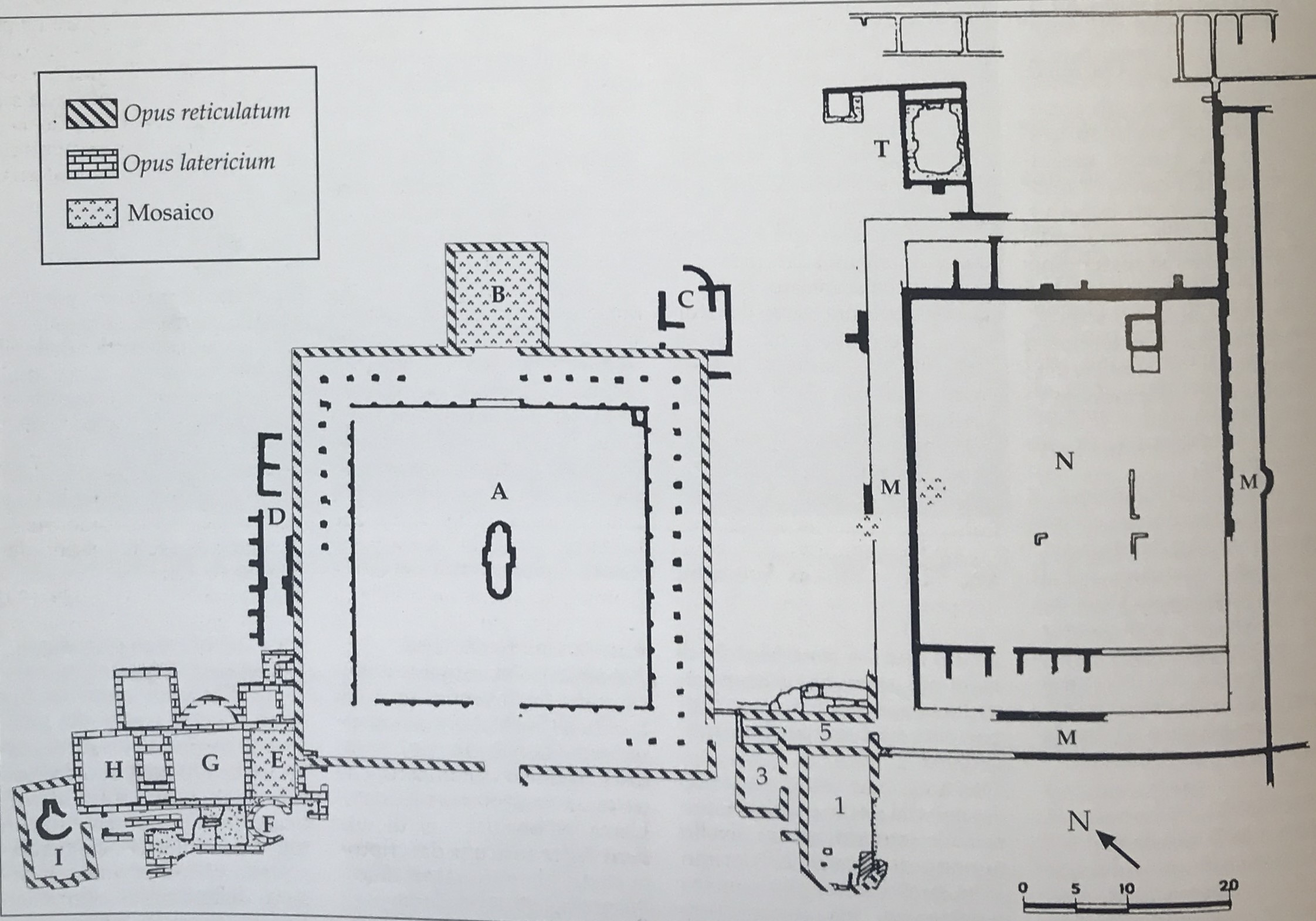
Planimetria della Villa di Castel Fusano "di Plinio" (da De Franceschini 2005, p. 260, fig. 93.1)

Planimetria della Villa di Grotte di Piastra a Castelporziano (da De Franceschini 2005, p. 265, fig. 96.1)
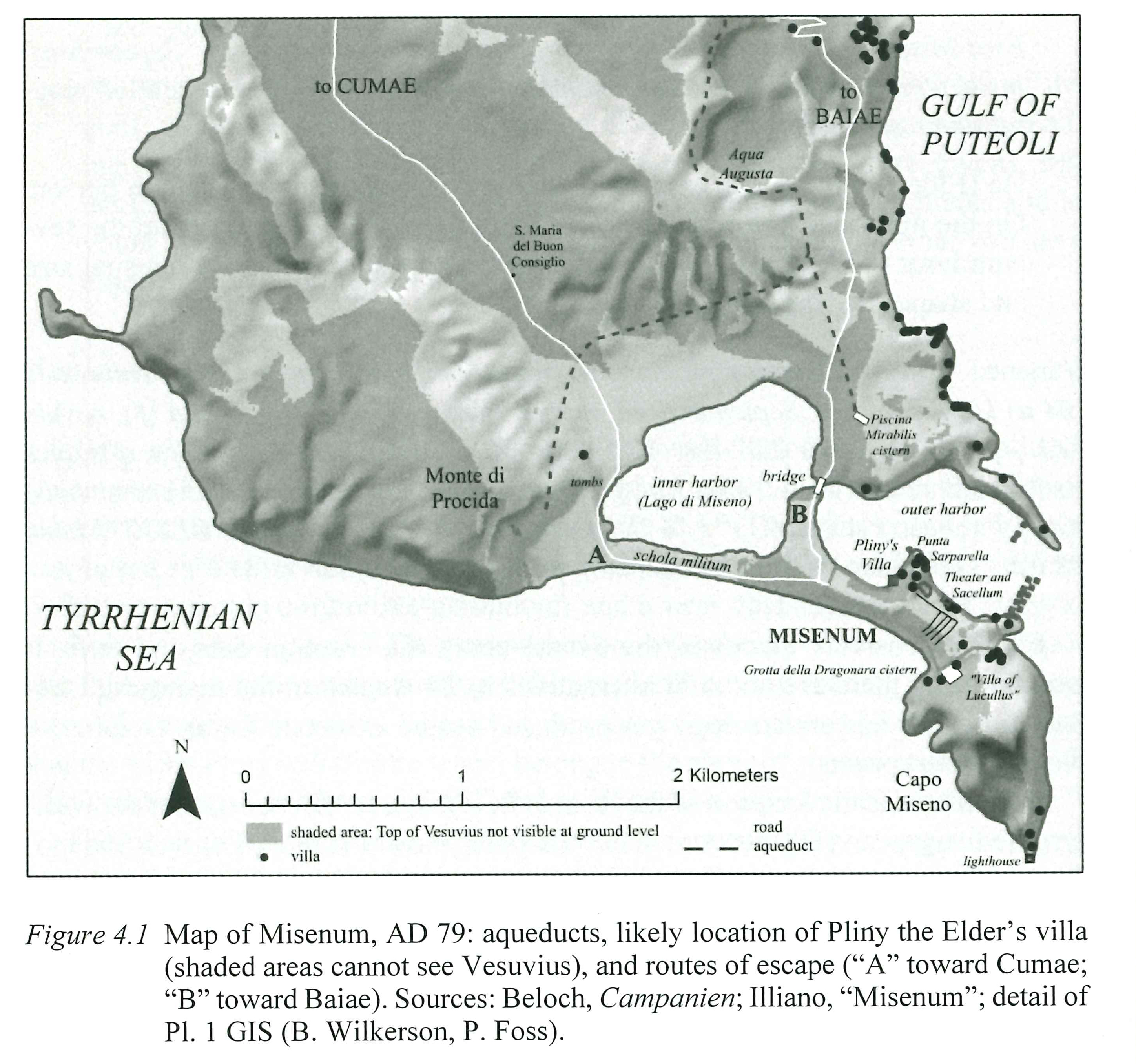
Mappa di Misenum, con ipotesi di localizzazione della domus dove soggiornava Plinio il Giovane nel 79 d.C. (da Foss 2022, p. 178, fig. 4.1)
About the author
Marta Maria Perilli - 0000-0001-6883-7286
Università degli studi di Firenze
Informations
Cita come: Marta Maria Perilli, The Libraries of Pliny the Younger (and Their Relationship with the Books of Pliny the Elder)_Scheda Letteraria, anno 2023, DOI 10.35948/DILEF/Dalib/22 contenuto in Valeria Piano, Barbara del Giovane (a cura di), DaLiB. Dal Libro alla biblioteca, DILEF Unifi 2023.
Ricevuto il: 03/08/2023
Pubblicato online il: 28/09/2023
DOI: 10.35948/DILEF/Dalib/22
Copyright e licenza d'uso: https://dalib.it/contenuti/informativa/8261
Progetto finanziato da: